Intentions for Buying a Book

Wardah Books, Singapore

Wardah Books, Singapore

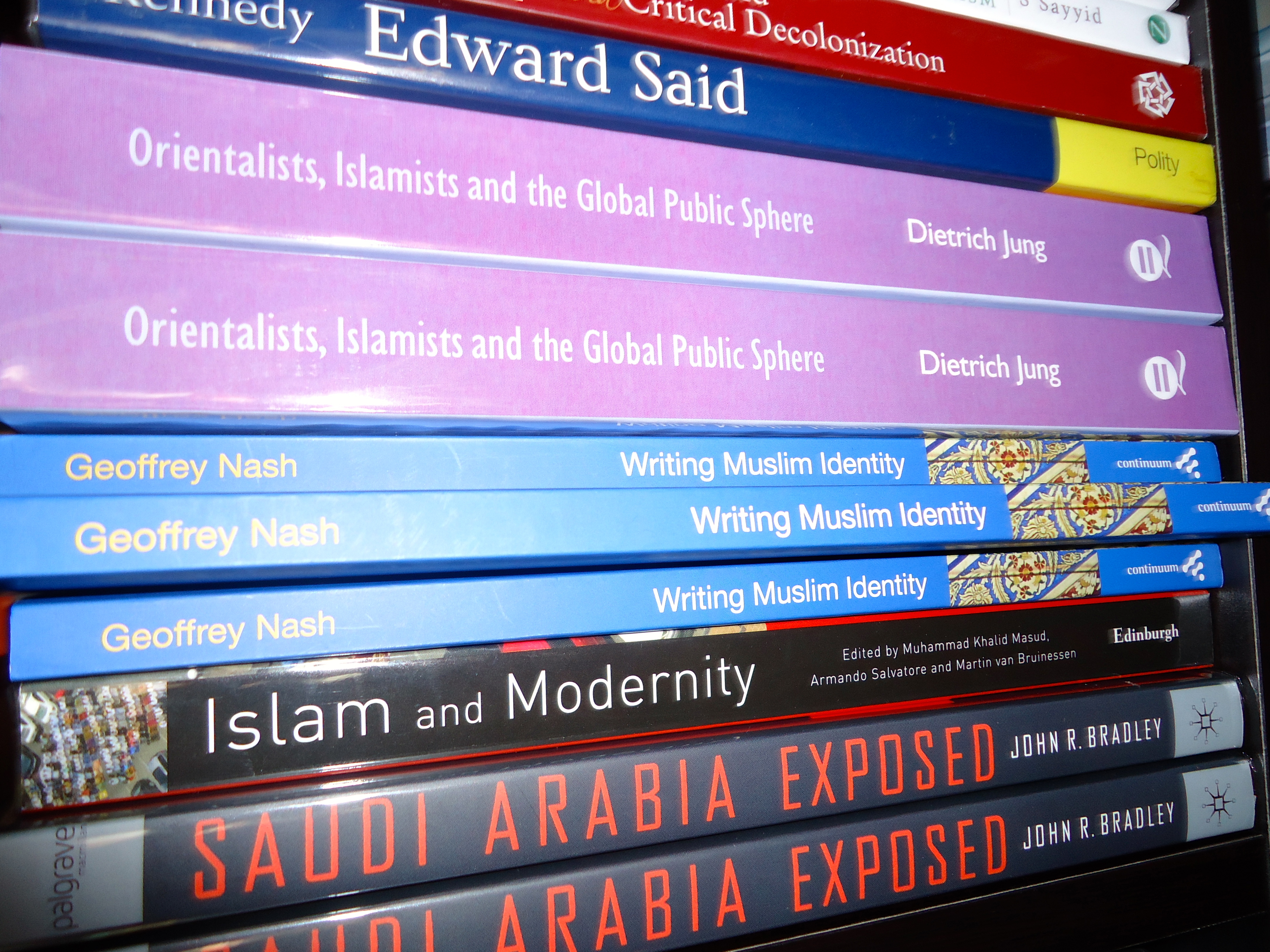
I was looking at the books in my room that desperately need a home (oh the challenges of bookshelf purchases!), and while wondering whether I should firmly resolve to strictly be a library user in the future, I came across these lovely intentions for buying a book. It was a reminder that when the intention with which you do something is wider than simply yourself, that action can become something good. I’m posting it here to keep the reminder fresh.

The Intentions for Buying A Book

  1. Intend to benefit from it, inwardly and outwardly
  2. Intend to occupy your time virtuously
  3. Intend to learn what is good
  4. Intend to protect and preserve knowledge
  5. Intend to help others, if someone asks to borrow it
  6. Intend to spread knowledge
  7. Intend to occupy yourself with it so as to keep away from idle talk.”

~Source: The Book of Intentions, by al-Habib Muhammad bin Alawi al-Ayadurus

Stay Tuned to This Space! It’s time to Tell A Story

I just can’t anymore. I can’t open up another book frustrated about the stories of oppressive arranged marriages, the choices characters need to make between “culture and self expression”, their intense desire to be accepted by wider society, and their descriptions of self loathing – the list goes on, but I can’t read stories that leave me miserable. As a reader, I am not uplifted or enriched by narratives structured by such narrow binaries, and they do not represent me.

I say this because today I started a book that was full of such moments (it was assigned by a book club I joined recently), and the experience made me realise that it’s time to take writing more seriously. Not because I want to explain the life of a Muslim woman to other people, but because for myself, I want to tell a story that I would want to read, and I think people I care about would want to read too. And so though the blog posts will still continue, I’ve started on a longer writing project.

If you’re interested in following along/getting updates, please do stay in touch via email or the Facebook page.  And if you have advice about sustaining longer writing projects, please do leave a comment/send an email. Here we go!

Observing, Understanding and Respecting Nature is Imperative of Deep Faith

The Bandung Institute of Technology (ITB) thanking students for remembering that some things decompose and others don’t.

 Last week, I read Green Deen: What Islam Teaches About Protecting the Planet, a book that calls you to open your heart and care deeply about yourself, your community, city, country, continent and our shared planet. I started the book after reading In the Footsteps of the Prophet, a book in which Tariq Ramadan writes:

“This relationship with nature was so present in the Prophet’s life from his earliest childhood that one can easily come to the conclusion that living close to nature, observing, understanding and respecting it, is imperative of deep faith. […]Being close to nature, respecting what it is, and observing and meditating on what it shows us, offers us or takes (back) from us requirements of a faith, in its quest, attempts to feed, deepen and renew itself. Nature is the primary guide and intimate companion of faith” (Tariq Ramadan, In the Footsteps of the Prophet, p.13)

This insistence that nature is needed for faith intrigued me, because I love the natural environment, but I am my most energetic and passionate when I’m in a beautiful city. I love the gleam of skyscrapers, the chatter of coffeeshops, the bustle of a crowd, and the feeling you get in a large city that you could meet a wonderful new friend just around the corner. This book however, asks us to think about the world that our city hides from us. It asks us to think about where food comes from beyond the grocery store, the scarcity of water beyond our (Western) household taps, how polluting energy sources adversely impact the planet, and where waste goes beyond the ‘chutes’ in our apartment building or the garbage can outside our house. It acknowledges it is hard to be mindful of these things, but emphasizes that understanding chains of consequence is a key component of living an ethical life.
Continue reading

On Reading “In the Footsteps of the Prophet” by Tariq Ramadan

Beauty.

Beauty.

As I mentioned in my last post, over the past several days, I’ve been reading Tariq Ramadan’s book “In the Footsteps of the Prophet, a biography of the Prophet Muhammad (peace and blessings be upon him) that seeks to highlight lessons and points of reflection from his life and mission for the contemporary reader. It is a book that needs to be experienced for oneself, but below are a few reflections on lessons I gained from the read.

Continue reading

An Aperture of Serene Harmony

Liquid joy.

Liquid joy.

Like Okakura, I know that tea is no minor beverage. When tea becomes ritual, it takes its place at the heart of our ability to see greatness in small things. Where is beauty to be found? In great things that, like everyone else, are doomed to die, or in small things that aspire to nothing, yet know how to set a jewel of infinity in a single moment?

The tea ritual: such a precise repetition of the same gestures and the same tastes; accession to simple, authentic and refined sensations, a license given to all, at little cost, to become aristocrats of taste, because tea is the beverage of the wealthy and of the poor; the tea ritual, therefore has the extraordinary virtue of introducing into the absurdity of our lives an aperture of serene harmony. Yes, the world may aspire to vacuousness, lost souls mourn beauty, insignificance surrounds us. Then let us drink a cup of tea. Silence descends, one hears the wind outside, autumn leaves rustle and take flight, the cat sleeps in a warm pool of light. And, with each swallow, time is sublimed.

~ The Elegance of the Hedgehog, p.91.

N’Allez Pas Trop Vite (On Reading “How Proust Can Change Your Life)

“The vibrancy which may emerge from taking a second look is central to Proust’s therapeutic conception, it reveals that extent to which our dissatisfaction may be the result of failing to look properly at our lives rather than the result of anything inherently deficient about them.”  (Alain de Botton, How Proust Can Change Your Life, p.153).

I’ve read Alain de Botton’s book “How Proust Can Change Your Life”  twice recently. The first time I read it quickly on the way to work over a couple of days, but the second time it was a slow read, with a pen and paper handy to take careful notes and underline and paraphrase key points.  This approach felt fitting because the entire book is an argument to not be hasty.

It argues that we should take our time in describing something properly instead of resorting to cliches, that we should take our time making a judgement about someone instead of assuming income and formal education translates to virtue and intelligence, and that we should take our time to understand what life is teaching us when we experience difficulties. And in the perhaps most interesting chapter, we are asked to open our eyes and seek the beauty within our daily life.

According to Proust, we may be unhappy with our routine because popular art has told us that what we ought to value looks different. Reading his example of how an imaginary youth might seek out a museum because he cannot see the beauty in the everyday, I wondered if our expectations act as barriers to being fully rooted in where we live. I know for myself, I came to love Toronto deeply once I stopped seeking Vancouver within it, I loved Bandung deeply once I stopped thinking about Canada, and I have become much happier in Vancouver upon moving back once I stopped comparing it to Toronto. Instead of having specific expectations of what life should look like and thinking, “Toronto doesn’t have mountains!”, “Vancouver doesn’t have the same active Islamic learning scene!”, and feeling disappointed, I’ve been slowly learning to quiet down and appreciate each city for what it is.

The same could be said for life stages. Though I enjoyed graduate school, there was a danger to count down the days and wish the intensity to be over and working life to begin. Now that I’ve graduated and started working, it is easy to grumble through the commute, long for the weekend and exclaim with delight once Friday arrives. Fulfillment and happiness becomes something in the distant future, requiring external conditions  – being in the perfect job, in the perfect city, with the right company – to exist.

Aside from the impossibility of perfection, such an attitude ignores the fact that all the moments of your day, week, month, and year make up your life. Which is not to say one pretends to have a chipper attitude – delusion is not the aim – but simply that it is too easy to grumble and sleepwalk through existence.  The harder (and according to Proust) necessary work is to find ways to be as peaceful and appreciative as you can wherever you are. To stubbornly insist in seeing and spreading beauty. To have trust that what is challenging now will hopefully become easier and better later, but that requires succeeding in finding the good and lessons in where you find yourself today.

Go slowly Proust tells us, and look carefully, because life is too valuable and short for us to relegate living to a later time.

Oh Dear, It’s Raining (Again)

Though I don’t quite miss the chilly weather of Toronto, it’s strange to see rain on a daily basis now I’m back in BC.

For me, pouring rain and wind equals warm knitted sweaters, soup recipes that warm you up from head to toe and deep within, and Taboo and Risk for cold nights. And it means baking crumbly apple crisp, drinking cardamom chai in mugs the colour of the summer sky, and writing letters to far off friends on bright sunshiny paper.

And of course, it means a fresh reading list for those evenings when a warm blanket and tea is much more appealing than venturing outside.

And  that’s where you come in  readers. I’m nearly finished reading How Proust Can Change Your Life by Alain de Botton, and I’m curious..  What have you read recently/hope to read soon?  This is always one of my favourite/most referred to threads, so please do leave a suggestion in the comments below! Also, what does rainy weather make you think of?


The Last Gift By Abdul Razak Gurnah

London, 2010.

One of the joys of reading is finding a piece of yourself in the pages of a book and feeling like the world is a bit smaller because someone has understood and put into words the way you feel.  Recently I read Abdul Razak Gurnah’s book “The Last Gift” and it was a read that was packed with such moments.

The book is about a couple named Abbas and Maryam who have been married for  thirty years and their two children Jamal and Anna. Jamal is doing his PhD in migration, Maryam is frustrated and uncertain about her long term relationship and the four of them are a family who know little about each other’s lives. When Abbas suffers from a diabetic crisis and a stroke at the beginning of the book however, the stories and secrets of their family begin to emerge.

More than simply an interesting novel, it is a fascinating and thoughtful read that addresses themes of identity, immigration, belonging, family, relationships, duty and love. Though we may not have deep secrets we’ve all had that feeling of realising that there is much we don’t know about those we love, and in its juxtaposition of a family oblivious to the thoughts and history of one another, and observations about what it means to belong and to feel foreign in a place more generally, this book makes you think deeply about how you define the word home, and the cruelty and harshness we often show to those we care about the most.

In addition to asking its reader to think about what it means to be a family, it asks the reader to think about the privilege in our own lives. It points out the conversations we may enter not considering the assumptions we are making about the lives of others or the privilege involved when we expect others to answer our very personal questions.

Below, some of my favourite, most memorable passages from the book.

On Learning

There was a library, with hundreds of books that he could take home to read if he wished. It was like all his schooling, until then had taken place in a small room, a small empty shut away room. Then someone had opened the door and he found out that the room was a tiny little cell in a huge building. (p.128)

On Knowledge and Adulthood..

He felt that he was at an important moment in his life although he was not sure of the source of this feeling. Perhaps it was a sense of impeding decisions, that for the first time in his life he would be able to choose what he would do with himself. He considered this and decided that he did not think it was that. Perhaps it was to do with approaching the end of his PhD, a sense of completing a job and it was this which made him feel grown up, an adult, an agent in the world. He did feel that sense but that was a plodder’s delight, satisfaction at (nearly) getting a job done, not any expectation of having arived at transforming knowledge. (p.85)

On epistemologies..

It was what he studied, migration trends and policies in the European Union. He could describe the patterns and provide the historical context, locate this wave from the Maghreb and its destination and that one from Zimbabwe and how it dispersed. He could construct tables and draw graphs, yet he knew that each one of those dots on his chart had a story that the graphs could not illustrate. He knew that from his Ba, and he knew that from the faces that he saw in the streets, and from the silent spaces in the reports he read. He knew that it was a clutter of ambition and fear and desperation and incomprehension that brought people so far and enabled them to put up with so much. (p.86)

On Stereotypes and Privilege

“They were all looking at her, waiting for her to speak, to tell them what her real nation was. She wished she could get up and leave, and walk quickly to the train station and travel to wherever her real nation was. She wished she had more panache, and knew how to charm people she did not like.” (p.116)

On War and Citizenship..

“They took no notice of those who marched, or of others who didn’t march but raised their objections in other ways, and went right ahead with their war. It made Jamal wonder what it meant to be a citizen: how millions of them listened to what they were told, and thought about it and were not persuaded, how so many people, all over the world, spoke their reluctance and outrage and disagreement, and yet how all of this made no difference. ” (p.126)

A Hologram for the King by Dave Eggers (Review/Reflection)

Singapore, 2012.

I saw an outstanding film called English Vinglish this weekend. Though the entire film is memorable, one of my favourite moments was a scene where the protagonist arrives in America visibly nervous about how she’ll manage with her limited English skills, and her seatmate on the flight wishes her well on her stay, and says, “Don’t worry about anything. It’s now time for them to be scared/worried about us“.

He is smiling and confident because of India’s rising economic strength, and in the film’s treatment of a woman altered understanding of herself and her changing relationship with her family, a larger tale of changing economic and cultural rules on a global scale is told.

Through a different story and different characters, the theme of the rise of “non-Western world” and the decline of America is also addressed in Dave Eggers’ new book A Hologram for the King. If you haven’t read it already, I recommend the read for the following five reasons:

1) The World is Changing

The book centers around the story of Alan, an American who comes to Saudi Arabia to bid for an IT contract for KAEC (the King Abdullah Economic City) on behalf of the company he works for called Reliant. KAEC is meant to be a massive project, and Alan desperately needs the commission from the contract to resolve his personal economic failures and limited career prospects. In telling his story, Eggers tells a larger story of America’s shifting financial power and the decline of its manufacturing sector. Against the “real-life” backdrop of an election that has focused so much on domestic jobs and restoring America’s economic strength, it is a timely read.

2) Urban Planning is Changing

The book argues that the most exciting and innovative planning work is not happening in North America anymore. In my own graduate work, I attended lectures where planners such as Larry Beasley praised the vision and resources of cities like Abu Dhabi while exhorting domestic planners to embrace the challenges of Canadian cities with creativity, not blind “rule-following”. In this book, the main character’s experience with municipal planning is facing obstacles/penalties when attempting to build a simple three foot wall; in KSA he is desperate that the King should follow through on his dream of an entire city. This book also suggests that  city building can act as a battlefield where war and hostile relations between nations can be addressed.

3) This book is beautifully constructed

Eggers describes KSA and Alan’s struggle with Saudi Arabia well.  He desperately needs the IT contract, but he is also fearful and incredulous of the place, and the combination leaves him weak. In one scene in particular, he passes by a playground and sees women in “charcoal black burqas” with their children. The sight of “their hands stretched forth” to play with their kids strikes fear in his heart. In another scene, he sees “young women in abayas, glittering abayas on their forearms, groups of young men hungrily inspecting them (p.220), and he judges what he sees.

As a result of this cognitive dissonance, he is incapable of performing anything successfully. He imagines tumours, he is unable to catch the hotel shuttle, and he cannot write successfully to his daughter, meet the KIng, or be with a woman. And his own powerlessness and tense waiting is carried throughout the book by sentences that are lean and efficient. Each sentence is carefully crafted. Each word has to fight for its survival.

4) Timely

The topic of the decline of America’s manufacturing sector is timely against the backdrop of the current US election, but throughout the book there are references to recent events that we should continue to think about. The events in Gaza. The BP spill. In these references, and Alan’s discomfort when thinking about them, there is an opening to think about our own understanding and responses to these events.

6) Thoughtful.

This book has some wonderful passages. Below are two of my favourites.

a) “Kit you know the key to relating to your parents now? It’s mercy. Children, when they become teenagers and then young adults grow unforgiving. Anything but perfection is pathos. Children are judgemental on an Old Testament level. All errors are unforgivable, as if a contract of perfection has been broken. But what if one’s parents are granted the same mercy, the same empathy as other humans? Children need more Jesus in them” (p.104)

b) “The Earth is an animal that shakes off its fleas when they dig too deep, bite too hard. It shifts and our cities fall; it sighs and the coasts are overtaken. We really shouldn’t be here at all.” (p.102)

Reading Status Anxiety by Alain de Botton

In the last year of my undergrad I took a number of English courses, and these classes taught me the importance of reading carefully. We read slowly, examining structure, noticing varied sentence length, admiring literary devices, researching the origin of epigraphs and learning the details of plot advancement. As someone who is often impatient to get to the end of a book, it was startling to discover how much is hidden in the art of telling a story. I learnt the words we choose matter, and the more you know about the milieu a book is set in, the challenges and debates it is responding to, the life and history of the author, and the connections that exist between one book and other works, the better your understanding of that particular book will be. The more closely you read, the deeper and more meaningful your encounter with a text.

Like those masterful English professors, Alain de Botton is an author who changes the way you understand the world.  He reads closely, and the results of his scrutiny are thought-provoking and meaningful.

Last week I read his book Status Anxiety, a book about modern life’s obsession with status. (Note: the examples and discussions are largely limited to the West). The book is divided into two sections – the cause of status anxiety (with chapters devoted to each suggested cause of snobbery, dependence etc). In this section he suggests a possible origin for status anxiety:

“A sharp decline in the actual deprivation may, paradoxically have been accompanied by an ongoing and even escalating sense or fear of deprivation. Blessed with riches and possibilities far beyond anything imagined by ancestors who tilled the unpredictable soil of medieval Europe, modern populations have nonetheless shown a remarkable capacity to feel that neither who they are nor what they have is quite enough.”(p.25)

The second section is called Solutions and has separate chapters on Philosophy, Art, Politics, and Religion. As a whole, the book is a reminder of how fleeting worldly status is, and through an exploration of classic literature, paintings, satire, western philosophy and tragedy, explains how different philosophers, artists and writers have sought to delink the association between the value of a person and their material worldly position.

It’s a wonderful read, particularly because the examples used are so interesting and familiar, and his insights are thoughtful.  He talks about the novel Middlemarch and how although Dorothea Brooke is a ‘failure’ by society’s standards,her soul is rich, and she is of one those ‘unvisited tombs’ who makes life better for those around them. In his discussion of another classic heroine, Fanny Price of Mansfield Park,  he describes Jane Austen’s intellectual project in all her books as an attempt to reform society and alter the lenses through which we view people. In Mansfield Park, Austen creates the character of Fanny Price, an obscure and poor individual who lacks worldly importance, and who cannot forgive and/or respect the Bertrams for their materialism, moral depravity and hypocrisy. Their wealth makes them ridiculous, it has no connection to making them subjects of respect. Fanny’s vision is clear and perceptive and when we see the world through her eyes, de Botton argues, we are more likely to view our own world through a clearer lens.

When explaining Greek tragedy, the author describes tragedy as a genre that expands our capacity to emphasize with how ordinary people can fall when confronted with specific circumstances. He notes that tragedies enable use to see people with nuance and complexity – unlike the media headlines that limit what we can learn and know about a person. To illustrate this point, he gives the example of the classic novel Madame Bovary. The novel was based on a newspaper article about a 27 year old French woman who killed herself after leaving her family and feeling stifled by her marriage.

For me, one of the most powerful parts of the books is its analysis of wealth. The author points out that

” Being truly wealthy.. does not require many things; rather it requires having what one longs for. Wealth is not an absolute. It is relative to desire. Every time we yearn for something we cannot afford, we grow poorer, whatever our resources. And everytime we feel satisfied with what we have, we can be counted as rich, whatever little we may actually possess. There are two ways to make a man richer reasoned Rousseau: give him more money or curb his desires.” (p.43)

He furthers this point by saying that we decide whether what we possess is enough by comparing ourselves to a referent group of people who we consider to be our peers. If we feel differences between us and our peers we feel diminished, but if the comparison shows us that we are equivalent or slightly better, then we don’t feel so bad, even though our actual situation in either case may be precisely the same.

More importantly, praise that is not deserved does not change who we are:

“Does what is praised become better? Does an emerald become worse if it isn’t praised? And what of gold, ivory, a flower or a little plant? Marcus aimed to take his bearings from the person he knew himself to be: “Will any man despise me? Let him see to it. But I will see to it that I may not be found doing or saying anything that deserves to be despised.” (p.114)

“Rather than allow every instance of opposition or neglect to wound us, we are invited by the philosophers first to examine the justice of other’s behaviour.  Only that which is both damning and true should be permitted to shatter our esteem. We should forever forswear the masochistic process wherein we seek another’s approval before we have even asked ourselves whether that person deserves to be  listened to – the process, that is, whereby we seek the love of those for whom, as we discover upon study, their minds we have scant respect.” (p.117).

There is much more to be said as this is a very rich, wonderful text, but in summary, this book made me think about whether we have space to have conversations about anxiety, fear in modern cities. Much of this book is about how anxiety over status and social positioning has increased as modern life has become less hierarchical and more secular, and that arguably, something has been lost in the process. How do we create communities which are healthy for the mind, soul and heart, and where we can see the world in ways that separate material positioning from personal worth? This is perhaps a question de Botton answers in his newest book: Religion for Atheists, but I’m curious to hear the thoughts of others.

Additional resources:

The TED Talk about the book: