How Debates About Legitimacy and Technical Standards Can Mask Islamophobia

I stumbled upon an article today about an incident from Australia where “a community centre which also facilitated Muslim prayers” was denied a planning permit. The post in its entirety can be read here, but the following quotes from the article caught my attention:

What hurt most was the open vindictiveness displayed by objector neighbours who were passionately against having this centre in their backyard.

At times the objections bordered on hysteria, I still have them in my file – “these Muslims celebrate something called Ramadan where they slaughter animals on site”, “I am followed by Muslims who want to steal my credit card details” And then there is the hysteria that connects extremism around the world with the establishment of an Islamic centre. That somehow if an Islamic centre were established it would produce a wave of extremists that would destroy the community. This is the sort of hysteria thrown up with attempts to establish Islamic centres in Camden, Perth and more recently in Doveton and Monash. (…) Sadly what does hold sway are incidences of double parking, blocking of driveways, and excessive noise. That is sad and indefensible. (…) And yet it is easily reversible by exemplary behaviour stemming from humility and sincere concern for the plight of God’s Creations – people and the environment. “

Though I respect the sentiment, and do agree with the point that faith centres should think about how they are helping the greater whole, there are two issues here that require a closer look.

Continue reading

On Reading “In the Footsteps of the Prophet” by Tariq Ramadan

Beauty.

Beauty.

As I mentioned in my last post, over the past several days, I’ve been reading Tariq Ramadan’s book “In the Footsteps of the Prophet, a biography of the Prophet Muhammad (peace and blessings be upon him) that seeks to highlight lessons and points of reflection from his life and mission for the contemporary reader. It is a book that needs to be experienced for oneself, but below are a few reflections on lessons I gained from the read.

Continue reading

Mosques Tell of Meaning, Direction and Settlement

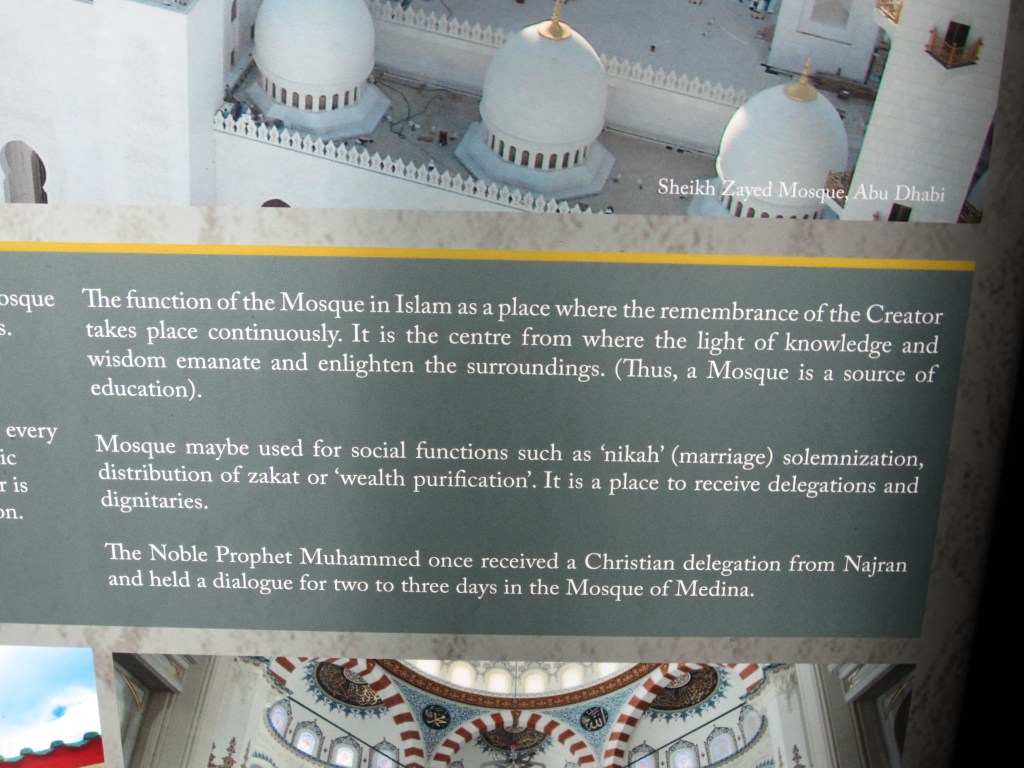
Display at the Sultan Masjid, Singapore.

Display at the Sultan Masjid, Singapore.

I’m lost in a book. On the way to work, during lunch, on the way back home, and in every spare moment I can squeeze out of the day, I’ve been reading “In the Footsteps of the Prophet” by Tariq Ramadan, a biography of the Prophet Muhammad (peace and blessings be upon him) that extracts lessons from his life with love, thoughtfulness and careful attention.  It is a spectacular read, and accessible for any audience. Before I reflect on the book in its entirety though (I’m halfway through) I wanted to reflect on a passage I read today that has relevance for how we understand and address contemporary conflicts about the development of mosques.

Continue reading

An Aperture of Serene Harmony

Liquid joy.

Liquid joy.

Like Okakura, I know that tea is no minor beverage. When tea becomes ritual, it takes its place at the heart of our ability to see greatness in small things. Where is beauty to be found? In great things that, like everyone else, are doomed to die, or in small things that aspire to nothing, yet know how to set a jewel of infinity in a single moment?

The tea ritual: such a precise repetition of the same gestures and the same tastes; accession to simple, authentic and refined sensations, a license given to all, at little cost, to become aristocrats of taste, because tea is the beverage of the wealthy and of the poor; the tea ritual, therefore has the extraordinary virtue of introducing into the absurdity of our lives an aperture of serene harmony. Yes, the world may aspire to vacuousness, lost souls mourn beauty, insignificance surrounds us. Then let us drink a cup of tea. Silence descends, one hears the wind outside, autumn leaves rustle and take flight, the cat sleeps in a warm pool of light. And, with each swallow, time is sublimed.

~ The Elegance of the Hedgehog, p.91.

N’Allez Pas Trop Vite (On Reading “How Proust Can Change Your Life)

“The vibrancy which may emerge from taking a second look is central to Proust’s therapeutic conception, it reveals that extent to which our dissatisfaction may be the result of failing to look properly at our lives rather than the result of anything inherently deficient about them.”  (Alain de Botton, How Proust Can Change Your Life, p.153).

I’ve read Alain de Botton’s book “How Proust Can Change Your Life”  twice recently. The first time I read it quickly on the way to work over a couple of days, but the second time it was a slow read, with a pen and paper handy to take careful notes and underline and paraphrase key points.  This approach felt fitting because the entire book is an argument to not be hasty.

It argues that we should take our time in describing something properly instead of resorting to cliches, that we should take our time making a judgement about someone instead of assuming income and formal education translates to virtue and intelligence, and that we should take our time to understand what life is teaching us when we experience difficulties. And in the perhaps most interesting chapter, we are asked to open our eyes and seek the beauty within our daily life.

According to Proust, we may be unhappy with our routine because popular art has told us that what we ought to value looks different. Reading his example of how an imaginary youth might seek out a museum because he cannot see the beauty in the everyday, I wondered if our expectations act as barriers to being fully rooted in where we live. I know for myself, I came to love Toronto deeply once I stopped seeking Vancouver within it, I loved Bandung deeply once I stopped thinking about Canada, and I have become much happier in Vancouver upon moving back once I stopped comparing it to Toronto. Instead of having specific expectations of what life should look like and thinking, “Toronto doesn’t have mountains!”, “Vancouver doesn’t have the same active Islamic learning scene!”, and feeling disappointed, I’ve been slowly learning to quiet down and appreciate each city for what it is.

The same could be said for life stages. Though I enjoyed graduate school, there was a danger to count down the days and wish the intensity to be over and working life to begin. Now that I’ve graduated and started working, it is easy to grumble through the commute, long for the weekend and exclaim with delight once Friday arrives. Fulfillment and happiness becomes something in the distant future, requiring external conditions  – being in the perfect job, in the perfect city, with the right company – to exist.

Aside from the impossibility of perfection, such an attitude ignores the fact that all the moments of your day, week, month, and year make up your life. Which is not to say one pretends to have a chipper attitude – delusion is not the aim – but simply that it is too easy to grumble and sleepwalk through existence.  The harder (and according to Proust) necessary work is to find ways to be as peaceful and appreciative as you can wherever you are. To stubbornly insist in seeing and spreading beauty. To have trust that what is challenging now will hopefully become easier and better later, but that requires succeeding in finding the good and lessons in where you find yourself today.

Go slowly Proust tells us, and look carefully, because life is too valuable and short for us to relegate living to a later time.

Negligence Deadens Desire

 I think life would suddenly seem wonderful to us if we were threatened to die as you say. Just think of how many projects, travels, love affairs, studies it – our life – hides from us, made invisible by our laziness which, certain of a future, delays them incessantly.

But let all this threaten to become impossible for ever, how beautiful it would become again! Ah! if only the cataclysm doesn’t happen this time, we won’t miss visiting the new galleries of the Louvre, throwing ourselves at the feet of Miss X., making a trip to India.

The cataclysm doesn’t happen, we don’t do any of it, because we find ourselves back in the heart of normal life, where negligence deadens desire. And yet we shouldn’t have needed the cataclysm to love life today. It would have been enough to think that we are humans, and that death may come this evening.”

Marcel Proust, quoted in How Proust Can Change Your LIfe.

Great Cities Are Like Great Books

Bandung 2012

Bandung 2012

You’re no use to Toronto if you only know Toronto. You’ve got to leave and see other places. Great cities are like great books. As a planner, you have to see as many as you can.  – Joe Berridge, Urban Strategies

A doctor spends years learning the intricacies of the body. An artist spends years learning their craft. But how does one become a person with a deep knowledge of cities?

One answer is to travel. Last year as graduate students we had the opportunity to sit with Joe Berridge of Urban Strategies and Ricky Burdett, the Director of the LSE Cities program in a small student seminar after a large public lecture, and both of them gave the same advice. That as young planners seeking to develop our skills, we have to leave Canada for a few years and immerse ourselves in studying the great metropolitan cities.  Both of them also strongly advised me to learn Arabic.

When I went to Bandung this summer, I thought a lot about this advice.  While I think there are caveats to travel – that you must do so responsibly, ethically and intentionally and not with a selfish desire to collect ‘cool experiences’, seeing the tremendous social capital of Bandung (theories around social capital began in Indonesia) was a lesson that travel has the potential for good. Visiting Singapore was another tremendous education.

I read a WashingtonPost piece this week about a growing trend of Americans leaving the States and going to Asia and the ME to work. Though the article is about people moving out of America because they can’t find employment locally – I’ve been thinking about the article ever since. Though Canada has always been home, perhaps at some point to be a well rounded planner it is necessary to take one’s anxieties about major moves and reframe that into intentional learning in a new location. In the meantime, I’m lucky to be close to an academic library, and right now there is a stack of books in my room about Indonesia and Cairo, and how faith is negotiated in cities (questions that I find particularly compelling) more generally. As I read and continue my studies, I hope to share thoughts here with you. I was in Toronto recently for my convocation ceremony, and being in the city again and having long chats with friends and mentors over chai and good food was an energising and inspiring reminder that though the unknown is scary, it’s a gift to be young and at the beginning of your learning and contributions.

(Below, notes from the seminar I mentioned above.)

Ricky Burdett

  •  LSE started a program that combines city design and social science. It’s the only school of social science that bring these issues together
  • Book: Living in the Endless City. Also has a website that is updated quite regularly
  • Discipline of understanding cities is about two dimensions: macro and micro. People may be thinking at one scale and not think about other scale at all. Cities are aging.  European cities are aged, but African cities are very young cities.
  • Importance of being interdisciplinary in dealing with issues. It has the risk of being an amateur of many things and a specialist of nothing. But that is what is necessary for good cities: need to know a bit of everything.
  • Design is one of many components.
  • In many cities, people show much more interest (than is shown in Canada) in what other cities are doing. City builders look internationally to see what other places are doing. Expecially in when sitting in relative comfort of Toronto, important to look at Bangkok.
  • You don’t want to have no idea what is going on rest of world. Need to bring where you are into your understanding of the rest of the world. Be an actor, know what’s going on.
  • We talk about phenomenon: but not the shape of cities.
  • Mexico city: endless city because it doesn’t end, but also not classical form of European cities.
  • 7-8 years of LSE Cities research is framed by three statistics:

a)2% of earth’s surface is occupied by cities.
b)53% of world’s population lives in cities.
c)33% of city dwellers live in slums

  • People move because they have a better opportunity of quality of life for children.
  • Mumbai like living in bird of gold because if things work you come in at the bottom, move up and then you fly. No doubt that urbanization comes with massive benefits if you channel urbanization properly.

Q: Where do planners fit into the developing world?
A: What is role of someone whose role is formal planning regulation in places of informal planning regulation? There is space but it requires a different way of doing planning. 75% of world’s CO2 emissions are produced by cities. As economy improves, people expect dignity of basic amenities and “modern facilities”. Not difficult to find tower blocks in new age cities. Don’t believe in one normative approach of cities, of someone saying “do it this way, and any other approach is wrong”. If wanted to be normative though, New York is good. It has continuous housing stock, and urban fabric. Very little possibility of resilience in totally zoned cities.

Mexico City, 2005.

This shows how we go from social to environmental. In 2005, there were 4 hour commuting times per day.The more city is spread out, the more infrastructure spreads, therefore can’t support a bus. Infrastructure of 22 million people is spread this way. Think about what kind of police officer and nurse will you be with those kind of commute times? What kind of family will you have? Think of your social life and what you are like as a parent.
Convenience mentioned as something as very important in HK. Everyone wants to be 12 minutes from work. In Rome, restaurant and friends are important. So context is always important.

There Has To Be More to Our Research Than A Helping Narrative

“Research reflexivity refers to researcher’s awareness of the self in the research process. But has to be more than that one line in your paper where you identify your identities. It is important to think about where you want to travel and what your trajectory will be. Your positionality. Ask yourself: why do you want to study that? What is it in your heart that brings you to that? There has to be more to our research than a helping narrative. This requires doing work on yourself, which can be scary, but ask yourself: what do I want as a person? What is the journey I want to be on? And don’t let your research end. Disseminate what you learn.”

~ Benita Benjun, Nov 1st 2012, Innovative Methodologies in Bridging Theory and Practice/Policy on Community-based Research UBC.

Oh Dear, It’s Raining (Again)

Though I don’t quite miss the chilly weather of Toronto, it’s strange to see rain on a daily basis now I’m back in BC.

For me, pouring rain and wind equals warm knitted sweaters, soup recipes that warm you up from head to toe and deep within, and Taboo and Risk for cold nights. And it means baking crumbly apple crisp, drinking cardamom chai in mugs the colour of the summer sky, and writing letters to far off friends on bright sunshiny paper.

And of course, it means a fresh reading list for those evenings when a warm blanket and tea is much more appealing than venturing outside.

And  that’s where you come in  readers. I’m nearly finished reading How Proust Can Change Your Life by Alain de Botton, and I’m curious..  What have you read recently/hope to read soon?  This is always one of my favourite/most referred to threads, so please do leave a suggestion in the comments below! Also, what does rainy weather make you think of?


The Last Gift By Abdul Razak Gurnah

London, 2010.

One of the joys of reading is finding a piece of yourself in the pages of a book and feeling like the world is a bit smaller because someone has understood and put into words the way you feel.  Recently I read Abdul Razak Gurnah’s book “The Last Gift” and it was a read that was packed with such moments.

The book is about a couple named Abbas and Maryam who have been married for  thirty years and their two children Jamal and Anna. Jamal is doing his PhD in migration, Maryam is frustrated and uncertain about her long term relationship and the four of them are a family who know little about each other’s lives. When Abbas suffers from a diabetic crisis and a stroke at the beginning of the book however, the stories and secrets of their family begin to emerge.

More than simply an interesting novel, it is a fascinating and thoughtful read that addresses themes of identity, immigration, belonging, family, relationships, duty and love. Though we may not have deep secrets we’ve all had that feeling of realising that there is much we don’t know about those we love, and in its juxtaposition of a family oblivious to the thoughts and history of one another, and observations about what it means to belong and to feel foreign in a place more generally, this book makes you think deeply about how you define the word home, and the cruelty and harshness we often show to those we care about the most.

In addition to asking its reader to think about what it means to be a family, it asks the reader to think about the privilege in our own lives. It points out the conversations we may enter not considering the assumptions we are making about the lives of others or the privilege involved when we expect others to answer our very personal questions.

Below, some of my favourite, most memorable passages from the book.

On Learning

There was a library, with hundreds of books that he could take home to read if he wished. It was like all his schooling, until then had taken place in a small room, a small empty shut away room. Then someone had opened the door and he found out that the room was a tiny little cell in a huge building. (p.128)

On Knowledge and Adulthood..

He felt that he was at an important moment in his life although he was not sure of the source of this feeling. Perhaps it was a sense of impeding decisions, that for the first time in his life he would be able to choose what he would do with himself. He considered this and decided that he did not think it was that. Perhaps it was to do with approaching the end of his PhD, a sense of completing a job and it was this which made him feel grown up, an adult, an agent in the world. He did feel that sense but that was a plodder’s delight, satisfaction at (nearly) getting a job done, not any expectation of having arived at transforming knowledge. (p.85)

On epistemologies..

It was what he studied, migration trends and policies in the European Union. He could describe the patterns and provide the historical context, locate this wave from the Maghreb and its destination and that one from Zimbabwe and how it dispersed. He could construct tables and draw graphs, yet he knew that each one of those dots on his chart had a story that the graphs could not illustrate. He knew that from his Ba, and he knew that from the faces that he saw in the streets, and from the silent spaces in the reports he read. He knew that it was a clutter of ambition and fear and desperation and incomprehension that brought people so far and enabled them to put up with so much. (p.86)

On Stereotypes and Privilege

“They were all looking at her, waiting for her to speak, to tell them what her real nation was. She wished she could get up and leave, and walk quickly to the train station and travel to wherever her real nation was. She wished she had more panache, and knew how to charm people she did not like.” (p.116)

On War and Citizenship..

“They took no notice of those who marched, or of others who didn’t march but raised their objections in other ways, and went right ahead with their war. It made Jamal wonder what it meant to be a citizen: how millions of them listened to what they were told, and thought about it and were not persuaded, how so many people, all over the world, spoke their reluctance and outrage and disagreement, and yet how all of this made no difference. ” (p.126)