On Reading “Men Explain Things to Me” by Rebecca Solnit

The blessing of public transit (October 2014, NYC High Line)

The blessing of public transit (October 2014, NYC High Line

“Yes people of both genders pop up at events to hold forth on irrelevant things and conspiracy theories, but the out-and-out confrontational confidence of the totally ignorant is, in my experience, gendered. Men explain things to me, and other women, whether or not they know what they’re talking about. Some men. Every woman knows what I’m talking about. It’s the presumption that makes it hard at times for any woman in any field; that keeps women from speaking up and being heard when they dare; that crushes young women in to silence by indicating, the way harassment on the street does, that this is not their world. It trains us in self-doubt and self limitation just as it exercises men’s unsupported overconfidence (Men Explain Things to Me, Chapter 1).

My lunchtime read this week has been Rebecca Solnit’s book “Men Explain Things To Me”, and I really want you to read this book. Quite simply, it is a brilliant collection of essays written in different years that all touch on different aspects of violence, and regardless of your gender, it is an important read. Rebecca Solnit defines violence as “the refusal to treat someone as a human being, and the denial of the most basic of human rights, the right to bodily integrity and self-determination”, and notes that violence comes from the premise “I have the right to control you”. From this refusal to treat women as human beings, violence manifests itself in the way women are silenced, the way women are sexually harassed and violated, the ways in which women are not heard, the ways women are abused by intimate partners, the ways in which women and their histories and genealogies are silenced and erased, the ways in which non-quantifiable epistemologies are violently rejected, the ways in which the earth is violently abused, and so much more. The list goes on and on of how violence shows up in everyday life.

Continue reading

On Being Producers of Meaning (Gems from Men Explain Things to Me)

Journey home from Tsitsikamma (November 2015)

Journeying home from Tsitsikamma (November 2015)

I’ve wanted to read Rebecca Solnit’s book “Men Explain Things to Me” ever since it was published and (hurrah public libraries) I finally am reading the book now. It’s such an amazing collection of essays, and I really want to get a copy of the book for everyone I know. Proper thoughts coming soon, but for now, here is a beautiful gem from the book.

“My own task these past twenty years or so of living by words has been to try to find or make a language to describe the subleties, the incalculables, the pleasures and meanings – impossible to categorize – at the heart of things. My friend Chip Ward speaks of “the tyranny of the quantifiable.” of the way what can be measured almost always takes precedence over what cannot: private profit over public good; speed and efficiency over enjoyment and quality; the utilitarian over the mysteries and meanings that are of greater use to our survival and to more than our survival, to lives that have some purpose and value that survive beyond us to make a civilization worth having.

The tyranny of the quantifiable is partly the failure of language and discourse to describe the more complex, subtle, and fluid phenomena, as well as the failure of those who shape opinions and make decisions to understand and value these slipperier things. It is difficult, sometimes even impossible, to value what cannot be named or described, and so the task of naming and describing is an essential one in any revolt against the status quo of capitalism and consumerism. Ultimately the destruction of the Earth is due in part, perhaps in large part, to a failure of the imagination or to its eclipse by systems of accounting that can’t count what matters. The revolt against this destruction is a revolt of the imagination, in favour of subtleties, of pleasures money can’t buy and corporations can’t command, of being producers rather than consumers of meaning, of the slow, the meandering, the digressive, the exploratory, the numinous, the uncertain.” 
~Rebecca Solnit, Woolf’s Darkness: Embracing the Inexplicable, Men Explain Things to Me

You Ask for Directions from Those Ahead of You (Day 5 of ASRI)


Constitutional Court of South Africa (April 2015)

Constitutional Court of South Africa (April 2015)

Today is a very brief blog post (yesterday was a busy evening!) but I did want to share reflections of Day 5 of ASRI nonetheless. Yesterday we began Week 2 of the program and the theme of this week is Government. The day started with a learning, building and growing session in the morning to share reflections of the program thus far, and because there was lots to reflect on, the session stretched to a two and a half hour conversation.

I learnt a lot from listening and learning from everyone’s perspectives and experiences but felt hesitant to speak, though I did share some reflections at the end of our chat. I was hesitant because I wasn’t sure if there was much I could add to the conversation, and because since the programme started, I’ve been having an internal conversation asking myself whether I should be speaking. A someone who isn’t South African and who is new to the country, should I contribute to our discussions about the history of South Africa and how we can create a more just and equitable society? Though I am trying to learn lots and my husband and I debrief about each day during tea chats at home every night, I don’t know a lot of the references, I don’t know the history of country well and  I/my biological family didn’t experience the effects of apartheid first-hand. For that reason, I am still trying to figure out what my role is in forming solutions and sharing my thoughts about the course content, and I’m wary about assuming too much space in discussion circles. It’s something I’m still thinking about because I don’t want to presume to have knowledges that I do not have.

Having said that, I find blogging is a nice space where i can unpack my thoughts a bit, and here are some thoughts from today:
Continue reading

A Dose of Monthly Joy (Details On The April Bookclub)


(Natures Valley, South Africa, November 2015)

(Natures Valley, South Africa, November 2015)

This weekend was the February session of the Seriously Planning bookclub, and for the first time since the club started in Joburg, I didn’t finish reading the bookclub selection before we met to discuss the book. I’m still reading our February selection “On Being Muslim” and enjoying the book thoroughly so proper thoughts about the read to come later. Despite not having completed the book our discussion filled my heart with so much light. Our monthly chats are a source of joy and help me to be better at being me, something I find is true for reading in general, but something that is amplified when I’m talking about amazing books with incredible people. Yesterday our discussion was about faith, living Islam holistically, how our lives overall support or don’t support our religious lives, self – knowledge, listening and appreciating others, the importance of self esteem and what that actually looks like, having meaningful prayer in our lives, the importance of akhlaq (good character), traditional madrassa education, and the role of the Qur’an in our lives. It was wonderful, and I can’t wait till our next session.

We met at a restaurant called “My bread and butter” near Zoo Lake, and it was perfect for the bookclub. It’s a big open airy space with lots of light and beautiful wooden tables, and the food and drinks and cakes were delicious, and the staff was super friendly and polite.  And best of all, because it’s a big space it wasn’t loud at all, and we were able to talk and hear each other properly,

Our next bookclub selection is  “The Golden Son” by Shilpi Somaya Gowda.
Date: April 2nd 2016
Time: 10:00 am to 12pm
Where: Nice, 37 4th Avenue, corner 14th street, Parkhurst, 2193

To RSVP: Email seriously.planning@gmail.com

About the book: “Author of the bestselling Secret Daughter, Shilpi Somaya Gowda’s The Golden Son is about a young Indian doctor who leaves his village for a residency in the US. But he grapples with the expectation that as the oldest son, he is expected to inherit the mantle of arbiter for all village disputes. And he finds himself torn between a beautiful American girl and his old childhood friend..” (Via Amazon)

Wanting to catch up on old reads? Here is what we’ve read so far:

September: Journey of Discovery by Na’eem Jeenah and Shamima Shaikh
November: Ghana Must Go By Taiye Selasi
December: Istanbul by Orhan Pamuk
January: If the Oceans Were Ink by Carla Power
February: On Being Muslim by Farid Esack

Be a Doer Not a Dreamer (On Reading the “Year of Yes” by Shonda Rhimes)

Boulders Beach, Cape Town (May 2015)

Boulders Beach, Cape Town (May 2015)

“Dreams are lovely. But they are just dreams. Fleeting, ephemeral. Pretty. But dreams do not come true just because you dream them. It’s hard work that makes things happen. It’s hard work that creates change.
Maybe you know exactly what you dream of being. Or maybe you’re paralysed because you have no idea what your passion is. The truth is, it doesn’t matter. You don’t have to know. You just have to keep moving forward. You just have to keep doing something, seizing the next opportunity, staying open to trying something new. It doesn’t have to fit your vision of the perfect job or the perfect life. Perfect is boring, and dreams are not real. Just..DO. You think, “I wish I could travel” – you sell your crappy car and buy a ticket and go to Bangkok right now. I’m serious. You say, “I want to be a writer” – guess what? A writer is someone who writes every day. Start writing. Or: You don’t have a job? Get one. ANY JOB. Don’t sit at home waiting for the magical dream opportunity. Who are you? Prince William? No. get a job. Work. Do until you can do something else.” (Shonda Rhimes, The Year of Yes)

It is scary to admit that you are struggling with something and to confront parts of yourself that you’ve always ignored. Today I attended a personal and professional development workshop about becoming more self aware and better understanding oneself as part of the Auwal Socio-Economic Institute Future Leaders Fellowship Programme and as part of the workshop, we spoke about the Johari Window, a chart with four quadrants where one axis is labelled “knowledge of ourselves” and the other axis is labelled “knowledge others have about us”. In each quadrant lies a different “self”, and where others have knowledge about us but we do not have that knowledge ourselves is our blind self, or the self that is not known to us. Where we do not have knowledge of ourselves and others do not have that knowledge either, our unknown self can be found, and in that quadrant there is unknown personal potential and potentially exciting learning and growth. In the workshop someone asked how one goes about discovering their unknown self given that that self is composed of parts of yourself that are not known by you or by others, and in response, another participant shared that to learn about themselves they found it was helpful to have as many different experiences as possible.

This idea is echoed by Shonda Rhimes book “The Year of Yes” a funny and moving book that I’ve thoroughly enjoyed reading over the past few days. The book feels like a long conversation over a cup of tea, in which Shonda Rhimes imparts lesson after lesson on transforming one’s life for the better. Shonda Rhimes is the creator of Grey’s Anatomy and other shows (as she notes throughout the book, she owns Thursday night) and she opens the book by admitting that sharing about herself and being exposed and vulnerable feels terrifying, and that writing this book was a very very difficult process. Because sharing is difficult and something that makes her feel uncomfortable, she pushed through the fear and discomfort and wrote the book anyway.

The book gets its title from a conversation she had with her older sister Delores in 2013 when her sister was focused on making the Thanksgiving meal and Shonda Rhimes was telling her about a series of wonderful and amazing invitations she had just received. In response, her sister asks her if she is going to accept any of her invitations and Shonda is confused she hadn’t seriously contemplated accepting any of the invitations.  But as she leaves the kitchen to tend to her baby, her sister mumbles “You never say yes to anything”, and these six words become life-changing words that are the catalyst for rich experiences, new understandings and remarkable personal growth. The words made her feel deeply uncomfortable, and after realizing that her sister is right and that she is miserable, she decides to spend an entire year not saying no to anything even if it scares her. The book is a chronicling of her experiment and it is a fantastic book. It’s conversational, honest, personal, funny and most of all inspirational because Shonda is candid about her fears and challenges and does not attempt to present herself as perfect. Hearing about how she was able to discover new things about herself while still feeling scared about new things made me feel like I too can confront things that scare me and live a richer life for it.

The book was an important personal read because I identified with Shonda Rhimes description of herself as being an introverted shy person who has never wanted to be in the public eye. As a three year old, her happiest childhood memories are playing in the kitchen pantry with canned goods imagining worlds peopled with rich characters. I too remember playing lots of “pretend games” as a child and reading and telling stories enthusiastically to my nanny when I was three. As an adult, Shonda Rhimes admits that she doesn’t do interviews and the media events she has to do as part of her network obligations make her feel ill. She realizes that in interviews she only speaks in “Athlete Talk”, where”anything human, anything honest” she keeps to herself.  And so the first yes she tackles is an interview with Jimmy Kimmel about her political drama Scandal. From there the “yeses” only increase, and though each one is difficult in its own way, with each “yes” she becomes more comfortable and willing to embrace challenging and difficult moments. Among the things she does in that year and the months that follow it is lose over a hundred and fifteen pounds, give the commencement speech at Dartmouth in front of over 10,000 people, remove toxic people from her life, be a more forgiving mother to herself, make time to play (for her this manifests as spending time with her daughters) confront passive aggressive behaviour in other people, stop being a doormat, and speak the truths necessary for her to be her most authentic self (for Rhimes this involves a difficult conversation about never wanting to get married and ending a relationship). It’s an incredible year, and though it is not at all a compehensive list here are some of my take-aways/favourite quotes from the read. (Disclaimer: I read this an an ebook on my Android tablet, and could only see the percentage of the book I had completed instead of page numbers. So none of the quotes have page numbers)

  1. It is possible to develop your weaknesses and become stronger and better at things you find difficult. With determination and courage, fear doesn’t have to stop you from living your best life. It is possible to become a more well-rounded person.
  2. In her Dartmouth speech, Shonda talks about finding a cause, and something weekly to give back to other people. I like this idea and am looking at literacy organizations this week that might be a good fit for me.
  3. It’s important to be honest and real about one’s struggles and admit that you find things difficult. Rhimes talks about how she is always asked by reporters how she manages motherhood and working life and while one response is to smile and talk about doing laundry late at night, the truth is that she has an amazing support structure and an amazing nanny named Jenny McCarthy. Shonda argues passionately that women are shamed for having help and for not mothering in ways that other people believe to be best (being judged for not making homemade treats is the example she gives) and tries to end “Mommy Wars” for herself and be open about what she finds difficult and how she works through it. Honesty is helpful for everyone, and Shonda talks about going through high school desperately trying to create Whitney Houston’s hair only to find out as an adult that Whitney Houston wore a wig. Knowing that even Whitney Houston doesn’t look like Whitney Houston would have saved her from a lot of heartache, and she makes a strong case for avoiding small talk, having real conversations and not misrepresenting your own life to others.
  4. You can be more productive and happier when you live an honest life. Shonda Rhimes talks in the book about how she hid from life and let issues fester before the “Year of Yes”, and that the complaining and regret took up a lot of mental space. As she committed to addressing her issues and confronting what she found difficult, she found that she had more free time because she got rid of the time wasted in “complaining and feeling sorry” for herself.
  5. You need to address your fears in a way that is authentic for you and allows you to be yourself. In the case of the Jimmy Kimmel interview for example, even though it’s a live show Shonda Rhimes realized that it would feel like a horrible experience for her if it was live. And so they did a taped show, something that was still scary and forced her out of her comfort zone, but didn’t cause her to stop functioning because of her emotional distress.
  6. It’s important to play as part of your self care. For Shonda Rhimes playing means being with her kids, and saying yes to playing for her meant saying yes to her “happy place” and giving herself the “permission to shift the focus of what is a priority from what is good for you to what makes you feel good.” When she made to play she was more joyful and better at writing and mothering and doing everything else that she does.
  7. Complaining is a waste of energy. In her chapter titled “Saying yes to my body” she describes the moment she realized that the seatbelt in her first-class airplane seat doesn’t fit her and how that moment triggered reflections about how and why she has become the size that she is. Her weight is upsetting not because she is striving for a specific body type but because she has kids and her joints ache and she is tired all the time. She recognizes how food is a way of hiding herself and also realizes that losing weight will mean having to give up foods that she loves and exercising, two things that she does not relish making a part of her life. What she realizes though is that she has at a yes crossroads, she either has to say yes to new health patterns or “say yes to “fatness” and buy bigger clothes, she can’t do nothing and still complain about her size. The deciding and doing is important because no health program will work unless “you decide that you are really and truly ready to do it. Meaning nothing works if you don’t actually decide that you are really truly ready to do it.”
  8. You need a team. Shonda talks in the book about her “Ride or Die” people, the people that are honest with her and wants what is best and who are sources of light in her life. As she describes it:

“It’s not merely about surrounding myself with people who treat me well. It’s also about surrounding myself with people whose self-worth, self-respect and values inspire me to elevate my own behaviour. People who requite that I stay truthful and kind and not totally crazy.”

Life is a team sport, and hearing how different people supported her along the way was a reminder to celebrate the fabulous people in my life and to strive to develop friendship that help me become the best version of myself.

9. Writing takes time and energy and dedication. This book was an testament to how much is needed of oneself in order to develop excellence. Elizabeth Gilbert, the author of “Big Magic”, the last book I read spoke about never wanting to be a mother, and Shonda Rhimes in this book speaks about recognising that between her work and her children there is no room for another person. As she describes it, there is a door, and behind the door there are wonderful things to be found, but the door is 5 miles away and you have to run towards it in order to be able to open the door. The run is procrastination and doodling and youtube videos and staring at a blank page, and the more you run, the fitter you become and the easier and faster it is to complete that five mile run. Writing takes daily practice and hearing about Shonda Rhimes dedication makes me want to be a better and more consistent writer.

10. Your writing can heal you. Shonda Rhimes speaks about how her character Cristina Yang held parts of her that she was unable to express, and said things that she was unable to say. Creating Cristina helped her understand herself and understand the world better.

Holding Multiple Colonial Histories in my Heart (Day 3 at the ASRI Future Leaders Programme)

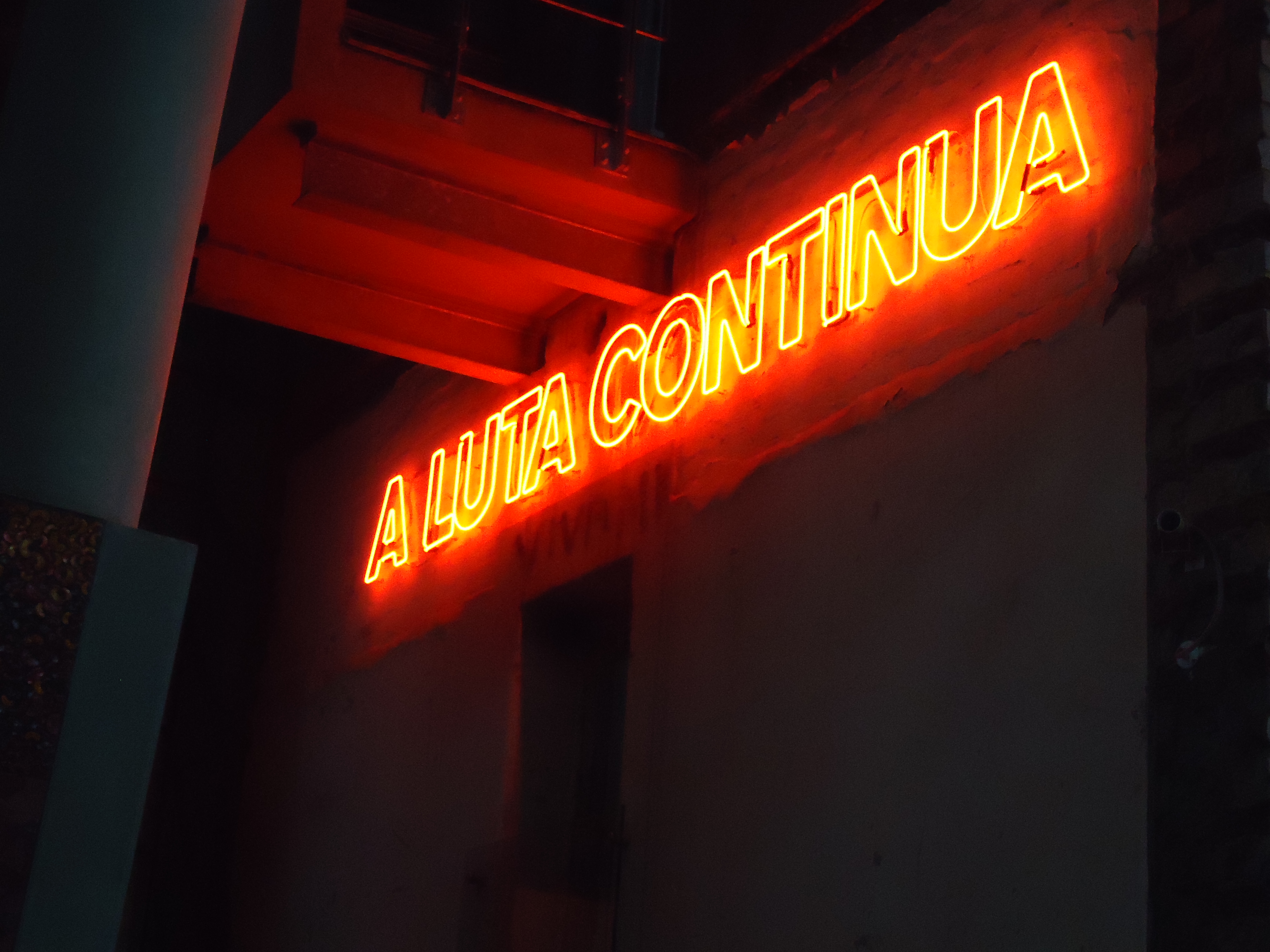
The Struggle Continues (Constitutional Court, Johannesburg, April 2015)

The Struggle Continues (Constitutional Court, Johannesburg, April 2015)

Today was a heavy day. In the morning we visited the Constitutional Court and the Old Fort where prisoners were housed during apartheid and after lunch we visited Apartheid Museum in Gold Reef City. Over the past couple of days we’ve been learning about how law can be an instrument that enables justice and how the Constitution protects different rights, and today was a stark reminder of a time in which the law was used to exclude, punish and oppress non-whites and when there were no protected rights for the majority of South Africa’s people.

Today was my second visit to the Constitutional Court (the first time was an incredible tour that a dear friend set up for us during our wedding week that is still one of my favourite things that I’ve done in Johannesburg thus far) and my first visit to the different jails in the Old Fort Complex. It was difficult to see the different sections of the Old Fort and  to see where and how black men were jailed in solitary and group confinement, to see where white prisoners were housed (admittedly, much nicer areas) and to see the Women’s Jail. Though there are some offices in the Women’s Jail for organizations that work for gender justice, by and large the structures of the Old Fort have remained intact.

What made the tour so powerful was that we had a passionate and knowledgeable tour guide who helped us understand a bit of what the Old Fort was like for its prisoners. Whether it was listening to him and to the audio testimonials in the exhibits, or seeing the buildings or reading the displays, all of it was hard, but it was important to learn how white prisoners were treated very differently from black prisoners and the ways in which this differential treatment manifested in the prison system. Some of these ways included floggings for black prisoners and the use of carefully designed tools used to physically punish prisoners, beyond appalling sanitary conditions (for example thirty minutes was allotted for 2000 black prisoners to shower once a week, which effectively meant people could only shower every three or four months despite doing hard labour all day), daily stripping and violation of prisoners, no toilets for those in solitary confinement, latrines located close to where food was served, poor food and no treats (though at Christmas time white prisoners received a pound of pudding each). The cells of the prisoners who were kept in solitary confinement are still there, and we walked inside the cells, closed the doors and thought about how prisoners were left in their cells for twenty-three hours a day, and how solitary confinement could last from fifteen days to up to a year, with prisoners considered dangerous forced to wear chains. On the back of the doors you can see graffiti done by prisoners at the time, and seeing the cells made the injustice of the place even more tangible.

In the Women’s Jail we saw awful conditions as well and were shocked by how tiny the cells were for black women prisoners. We read stories of sexual violence and of women who asked for solitary confinement as respite from assault, heard and read stories of women who miscarried, learnt about how women did not have access to sanitary products and heard stories/saw signs about children that were born in the prison. We learnt that thousands of children were breastfed in prison. By the time we left the prison, I felt as though I couldn’t hear another story, hear of another oppressive act.

Continue reading

Our Current Economic Policies Lead to High Unemployment (Day 2 at the ASRI Future Leaders Programme)

I woke up today thinking of Shonda Rhimes.  I am reading her book “The Year of Yes” as a library ebook, and at some point today – 20 something hours from now to be exact, whether I am done or not, the book will delete itself from my tablet. I am determined to finish. I peek at my book during breakfast, and  as we all eat lunch in a circle in the ASRI garden during our lunch break I sit with my tablet and read out passages to my husband. After work I rush indoors and sit in bed with pen, paper and my tablet unable to eat or chat except to read passages aloud until I am done reading. Afterwards I am exhilarated and emotionally spent from the read (Shonda is amazing, the book is fantastic and there are lots of life lessons that I need to ponder over further) and fall asleep very early in order to let my soul process what has just happened. Because of that I didn’t manage to blog properly about Day 2, but Shonda’s whole book was about saying yes to things that are scary and things that make your soul sing, and writing falls into both those categories. So before Day 3 starts, here are some quick reflections on our second day of the ASRI Future Leaders Programme.  On the whole, Day 2 was a wonderful, educational day with four different guest lectures who all further developed our knowledge of the Constitution and the impact of the law, and below are some of my (not comprehensive) take-aways from the day.

1) Our first speaker of the day was Mluleki Maronga from Section 27, “a public interest law centre that seeks to influence, develop and use the law to protect, promote and advance human rights.” Their name comes from Section 27 of the “South African Constitution which enshrines everyone’s right to health care, food, water and social security.” (Source: Section 27 Website) He was an engaging and interesting speaker, and one of the things he talked about was whether there is a difference between equality and substantive equality. There is, and we discussed how substantive equality is about bringing equality in tangible ways recognising that different groups have different levels of privilege and disadvantage. He quoted Mandela who said “We do not want bread without freedom, nor freedom without bread.” He also spoke about how it is important to know where we come from because only by understanding the location of pain can we focus our efforts on healing. Toward that end, he reminded us that South Africa comes from a history of “brutality and oppression” and that this oppression was manifest in at least three ways:

a) The Education System

  • South African had an act in 1953 called the Bantu Education Act that segregated schooling for black children, deemed the teaching of certain subjects unnecessary (for instance the teaching of math as a core subject) because the education system was designed for black students to simply take up what was seen as “their place in society”, and not designed to prepare them positions in the economy beyond what they were intended to take up.

b) Anti-black Urbanization

  • At the time of South Africa’s urbanization between 1904-1960, 80% of white people lived in cities versus only 32% of black people. It was a system of apartheid geography, and Mluleki read us a quote from the apartheid government saying “Cities are the white man’s creation. Black men may enter as long as he ministers to the white man’s needs, so long as he departs once he ceases to minster to those needs.” Aside from how that quote view black men, women are not mentioned at all and so you can see an erasure of women in the apartheid regime.

c) Land Dispossession

  • 87% of the population was on 13% of land during apartheid.

Other ways that this oppression manifested that came up in our discussion is through the economy (black people were unable to own means of production) and the health care system.

Hearing about these issues and our robust discussion of apartheid was a re-reminder that the impacts of apartheid can still be felt today and that in our own way, with the skills that we entered ASRI with and the skills we develop over the course of ASRI, it is so important that we contribute and do good work in society.

2) Our second speaker was Stuart Wilson, the Executive Director of SERI, or the Socio-Economic Rights Institute of South Africa. SERI is an non profit organization providing professional and dedicated socioeconomic rights and  assistance to individuals, communities and social movements in South Africa. If it is possible to have a crush on an organization I have one on SERI, and before the lecture when I looked up the organization I was amazed to see the range of work that they do. They do work on themes like housing and eviction, access to basic service, and political space and have a range of wonderful guides on their site on topics that range from resisting eviction to community organizing, to informal trading, rental housing and more. Stuart Wilson spoke about the contemporary moment in South Africa being characterized by fracture, and spoke about five or six of these fractures that exist in our societies today. The fracture I found the most interesting was the economic fracture, and he spoke about how since apartheid, poverty in the country has reduced only very slightly. Grants have expanded, but actual poverty has reduced very very little. We were vying for Brazil for the most unequal society in the nineties, but since then Brazil has invested a great deal in social programs and inequality in Brazil has been steadily reducing.

To learn more about fracture he gave us a book reference to look up: South Africa’s Insurgent Citizens: On Dissent and the Possibility of Politics by Julian Brown.

What was most interesting to talk about was that our economic framework is not designed to create jobs. South Africa has adopted the economic orthodoxy of Reagan and Thatcher, and despite public officials talking about high unemployment (in South Africa total unemployment is about 40%) the actual economic policies are meant to keep inflation down so that money retains its value. This is important for the very rich who have a great deal of money invested, but it does not create jobs. In fact, Margaret Thatcher was known to say that structural unmployment is a price worth paying to keep currency values up. Economists say that if inflation is below 20% (in South Africa it is well, well below that) the impact of inflation on the poor is very little, but it has a significant impact on the very rich because the value of their money decreases. When inflation is low interest is high, which makes it harder to borrow money. It makes it harder to spend money, it makes it harder to entrepreneurs to take risks, and the overall result is that high interest makes it difficult to generate economic growth. It hurts entrepeneurship and it has an effect on employment. (We also talked about low tariffs make it difficult to develop new industries, and South Africa has very very low tariffs, but that’s a conversation for another day)

This is all perhaps familiar if you took macroeconomics in school. What struck me afresh yesterday (perhaps it was the way he was explaining it because he really was a fantastic lecturer) though is that I’ve spent lots of time this year looking at immigration policies and South African visas, and the basis of  work restrictions of non South Africans (and especially spouses of South Africans) is based on the premise that there is high unemployment in the country, and so before any employer can hire a non South African, there is elaborate paperwork and steps required to prove that no other South African can do that job. And once that happens visas need to be applied for from one’s home country. To realize that the entire economic policies of the country are stifling employment is surprising, and makes these work restrictions and visa rules make even less sense than they did before. It also made me really want to strengthen my policy making skills as the public policy courses I took in my Masters and undergrad were a while ago, and knowing how to make evidence based policies seems like a good skill.

Our last two speakers were Michael Power from the African Legal Centre who spoke about working with communities and starting an NGO, and Jacob van Garderer from Lawyers from Human Rights who spoke about the work of LHR and the work of lawyers during the apartheid regime and how the law was used creatively as a tool of resistance.


On Embracing the New (Day 1 at the ASRI Future Leaders Programme)

Embracing the Unexpected (Feb 2015)

Embracing the Unexpected (Feb 2015)

Having a library card and being engaged in interesting work are two of the things I need to make a place home. In September 2015, I got my Joburg library card and today was my first day at the Auwal Socio-Economic Research Institute (ASRI for short), a pluralist domestic public policy institute based in Johannesburg. Along with 29 other fellows, I’m taking part in the ASRI Future Leaders Fellowship Programme, a six month program aimed at “producing effective and innovative change agents who can bring about transformative change in South African society”. 2016 is the first year of the Fellowship Programme and I’m so excited for the learning and growth that God-willing, will take place over the next six months. The theme for Week 1 is Law and Justice and Day 1 was a wonderful and interesting introduction and overview of the South African Constitution. We were graced by a visit from Janet Love, the National Director of the Legal Resources Centre (and overall rockstar) and Richard Chemaly of Pro Bono.org. The LRC is South Africa’s largest public interest human rights law clinic, and Janet Love’s remarks on justice, law, and the process of writing the Constitution were thought provoking and inspiring. After lunch, Richard Chemaly did a workshop that was a closer examination of the Constitution and an overview of rights theory, the Bill of Rights, and Section 9 Institutions ( An example of a Section 9 Institution is the South Africa Human Rights Commission, or the Public Protector.) I now have a purse-sized copy of the Bill of Rights which feels very exciting, and I’m glad that we got a chance to look at it closely with him.

Continue reading

Creativity is the Property of Everyone (On “Big Magic” by Elizabeth Gilbert)

Joburg Skyline and Flowers (happiness things)

Joburg Skyline and Flowers (Home, Sept 2015)

It isn’t always comfortable or easy – carrying your fear around with you on your great and ambitious road trip, I mean – but it’s always worth it, because if you can’t learn to travel comfortably alongside your fear, then you’ll never be able to go anywhere interesting or do anything interesting.
And that would be a pity, because your life is short and rare and amazing and miraculous, and you want to do really interesting things and make really interesting things while you’re still here. I know that’s what you want for yourself because that’s what I want for myself, too.
It’s what we all want.
And you have treasures hidden within you – extraordinary treasures – and so I, and so does everyone around us. And bringing those treasures to light takes work and faith and focus and courage and hours of devotion, and the clock is ticking, and the world is spinning, and we simply do not have time anymore to think so small. (p.37, Big Magic)

“It’s a simple and generous rule of life that whatever you practice, you will improve at. For instance: if I had spent my twenties playing basketball every single day, or making pastry dough every single day, or studying auto mechanics every single day, I’d probably be pretty good at foul shots and croissants and transmissions by now.
Instead I learned how to write.” (p.145, Big Magic)

“Meeting Winnifred though, made me realize that your education isn’t over when they say it’s over; your education is over when you say it’s over. And Winifred-back when she was a mere girl of eighty – had firmly decided: It ain’t over yet.
So when can you start pursuing your most creative and passionate life?
You can start whenever you decide to start. ” (p.148, Big Magic)

A few months ago I spent a weekend mentoring teenagers at a camp in Brits, South Africa, and in the early hours of the morning before my cabin was awake and in moments between mealtimes and sessions, I shared stories of my first few months in South Africa with my fellow mentors and new friends. And in December, my husband and I travelled to Durban for the wedding of a dear friend, and in our post dawn walks on the beach or long chats over cups of tea, we continued telling stories of my transition to Joburg and the early days of our marriage. Throughout those conversations, the possibility and importance of chronicling some of these reflections and transition stories into a longer piece of writing was a topic of conversation – I was convinced that my story wasn’t interesting enough to be told (and that I didn’t have the ability to tell it in any case) but my husband and the friends we were speaking to felt otherwise.

For me, the word writer conjures up someone armed with an MFA, proper published writing credits to their name, a dedicated writing practice, no troubles with procrastination, natural talent, ideas that bubble forth constantly and an understanding of semi-colons.That description does not fit me, and so although the act of writing fills my heart with joy it has always seemed inaccurate to think of myself as a writer, and I’ve never felt like writing a longer piece of work is something I could do.

Despite this, lately I’ve been thinking a lot about why and how we tell stories and why we write, and how to know when you should and indeed can, tell a particular story. As part of this thinking, I recently read Elizabeth Gilbert’s new book “Big Magic: Creative Living Beyond Fear”. (I confess, part of why I read the book was that I was hoping to hear that creativity is an inherent characteristic so that I could win the internal argument I’ve been having with the words of my husband, family and friends about writing, but alas, no such luck.)

Continue reading

On Reading “If the Oceans Were Ink” and Details On Our February Bookclub

Unexpected beauties (Graaf-Reinet, South Africa November 2015)

Do you love books, cities and vibrant conversation?  The Seriously Planning Bookclub has been meeting in Joburg since September 2015, and thus far, our monthly gathering has been a wonderful way to read more and meet new people at the same time.

In January we read Carla Power’s book “If the Oceans were Ink”.  You can find thoughts about the read in the audio story below.

This month’s selection is “On Being a Muslim: Finding a Religious Path in the World Today” by Farid Esack.
Date: Feb 20th 2015
Time: 10:00 am to 12pm
Where: My bread and butter, 66 Tyrone Avenue, Parkview, 2193, Joburg

To RSVP: Email seriously.planning@gmail.com

About the book: “Funny, challenging, controversial, passionate and unforgiving, this is an unprecedented personal account of a Muslim’s life in the modern world. As an Islamic scholar, outspoken social activist and well-known commentator, Farid Esack is in a unique position to tackle the quandaries and challenges facing Muslims today. Whether it be cultivating a meaningful relationship with Allah or striving for gender equality and religious freedom, Esack combines personal insight with incisive analysis. Providing a devout yet practical guide for those seeking to re-engage with their faith in the modern world, this groundbreaking work will help believers and non-believers alike to appreciate the eternal relevance of the Qur’an and its teachings. Dr Farid Esack has an international reputation as a Muslim scholar, speaker and human rights activist.” (via Amazon)