On Understanding One’s Destination

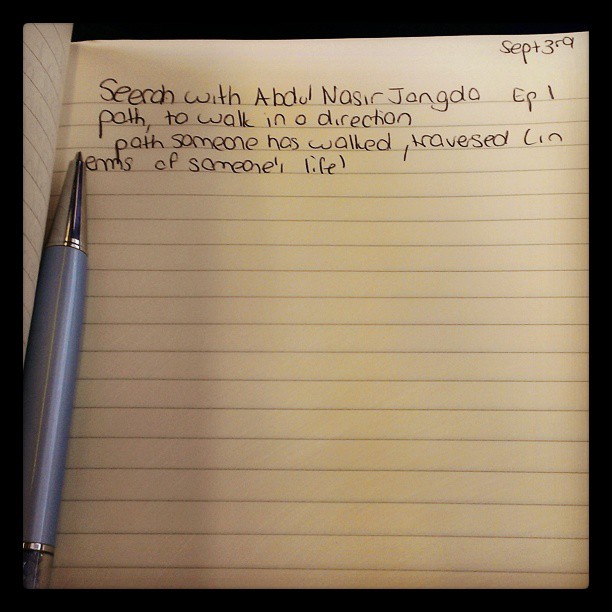
For the Seriously Planning Book Club, I’m reading a book right now called The Road to Mecca by Muhammad Asad, that so far, is a beautiful, introspective read about faith and identity. I read the following passage today and it struck me as worth noting in my digital notebook and with all of you – a powerful reminder that although it is important to live with purpose and journey in search of benefit, we ultimately can only fully understand where we are going/where we have been at the end of our travels.

But after all is there always a clearly discernible borderline between the mundane and the abstruse in life? Could there have been, for instance, anything more mundane than setting out in search of a lost camel, and anything more abstruse, more difficult of comprehension than almost dying of thirst?

Perhaps it was the shock of that experience that has sharpened my senses and brought forth the need to render some sort of account to myself: the need to comprehend, more fully than I ever done before, the course of my own life. But, then, I remind myself, can anyone really comprehend the meaning of his own life as long as he is alive? We do not know, of course, what has happened to us at this or that period in our lives; and we do sometimes understand why it happened; but our destination – our destiny – is not so easily espied: for destiny is the sum of all that has moved in us and moved us, past and present, and all that will move us and within us in the future – and so it can unfold itself only at the end of the way, and must always remain misunderstood or only half understood as long as we are treading the way.

How can I say, at the age of thirty-two, what my destiny was or is?

~The Road to Mecca, Muhammad Asad, p.50

Toronto 2.0 (On Stories, Faith and Cities)

Warm your heart.

Warm your heart.

About four years ago, I ran a storytelling program called Terry Tales. Before it began, I imagined a “Moth-style” event where from the very first event, people would enthusiastically tell stories about their lives to a group of strangers.

What I discovered instead is that it takes time and confidence to realize that you have a story and experience to share. Instead of providing a space for performances, our events were about a circle of chairs, an open room, and tea and cookies to break the ice. The conversation was intimate, unexpected and dynamic, and participants ranged from first year students, to PhD candidates to recent alumni/young professionals in the wider community. Every event was different because the participants grew each time, we blogged about the conversation afterwards, and many participants shared with us how important these bi-monthly gatherings became to them.

I stopped holding these events when I moved to Toronto for grad school, but Terry Tales taught me about the importance of spaces of community and the power of stories.  Whenever I’ve moved in the past, whether it was to Toronto four years, or to Vancouver two years ago, or most recently, back to Toronto this March, it’s been important to me to find non-alcoholic centric spaces for discussion, and to find others who were striving to grow spiritually, develop strong family relations, make deep community contributions, create/appreciate heart-nourishing art, live healthily, and protect the planet. So much of the time, the conversations I have about faith are from the standpoint of explaining oneself, and so its always been important to also find people with whom to have proactive, positive conversations that widen and deepen my understanding of what it means to live faithfully in the world. The further I get from my undergraduate experience, the more questions I have, and the richer these conversations become.

Now that I’m back in Toronto, I’d like to create a space for conversation on a regular basis. In many ways coming back to Toronto has been like moving to a new city altogether, and over the past couple of weeks I’ve been spending a lot of time listening and learning through one on one chats and large group settings. In large groups it’s been beautiful (for example) to witness the passionate debate at Canada Reads about how we understand difference, belonging, colonialism and marginalization in Canada today, to learn about the NFB documentary Highrise about the experience of living vertically in Toronto today, to participate in a Muslim Chaplaincy discussion about how people with disabilities experience inaccessible mosques, and to hear beautiful expressions from students of how faith and art connect, among other experiences.  In small settings, it’s been wonderful to exchange stories and perspectives over long chats and multiple cups of coffee.

Both encounters have been a reminder that that this is a city of countless stories, and telling and hearing our stories matter. Sharing one’s experience with others can be an act of discovery and identity formation, and for listeners, stories can act as both an entryway to unfamiliar perspectives and experiences and a bridge to discovering others with experiences similar to your own. In this spirit, Seriously Planning will, God-willing, offer programs on a regular basis on storytelling, books, dialogue and reflection.

For March, here are our upcoming events:

March 21st: Seriously Planning BookClub On “Amusing Ourselves to Death.”

March 24th: Seriously Planning Stories

For either these events, please email seriously (dot) planning (at) gmail.com (or RSVP on the FB event page) to confirm your attendance. Hope to meet you soon!

On Reading The Post Secular City (Part 1)

Some books require time to read and digest. In 2012, I started a book called Post-Secular Cities: Space, Theory and Practice, and I only recently finished the book. It’s been a deeply influential and meaningful read and each time I pick it up, I find something new to think about. The book describes the resurgence of religion in Western public life as “one of the defining features of this century” (Ley, 2011, p.5) and interrogates the postsecular city, defined as “a public space which continues to be shaped by ongoing dynamics of secularization and secularism.. while negotiating and making space for the re-emergence of public expression of religion and spirituality (Baker and Beaumont, 2011, p. 33).

In the introduction however, the editors of the book caution assuming a new importance to religion, because it may be that what has changed is simply  “a focus of gaze rather than the things themselves” (David Ley, xii). Now, a wider research community is noticing, and is being forced to respond to, the losses that occur when religion is ignored. The postsecular city matters because the “pluralism of postmodern philosophies and multicultural societies make such dogmatic closures no longer possible” (David Ley, xiii). This book matters for planners and others because while religious and spiritual values are evident in many different areas of public life (policy, governance etc), it is clearest in the built environment, and  “it is in the ‘urban” that the shift from secular to postsecular in terms of public space, building use, governance and civil society is most intensely observed and experienced (Ley, p.4).

The chapters in the book cover a wide range of topics from gender and faith in post secular cities, to the role of spirituality in planning practice, to visual representations of faith in Jerusalem, and deepen the readers’ understanding of postsecular cities by examining cities from a variety of lenses.

In the chapter, Post Colonialism and Religion: New Spaces of ‘Belonging and Becoming’ in the Post Secular City, authors Christopher Baker and Justin Beaumont examine how Quran study classes in the UK are “spaces of belonging” and “spaces of becoming”. In their study, participants surveyed described benefiting emotionally from connections made with other attendees, developing practices of citizenship, deepening their understanding of how to apply principles of Islam in pluralist communities and being able to reconcile their sometimes conflicting identities of ethnicity, religion and nationality. Instead of “simply” being religious classes, these study circles were often transformative spaces (Baker and Beaumont, 2011, p.42)

For these authors, this study brings up important questions, and calls to attention the work of Habermas on religious identities in the public square. According to Habermas:

“The traditional secular model of the public sphere, whereby the role of ‘community member’ (for example a religious community) is differentiated from ‘member of society’ is unsustainable… This differentiation lies in the tension between a cognitive level of belief (ie-the beliefs generated by the transcendental view of his or her religion) and the legal norms of the host community, whereby a secular society ‘tells’ the religious citizen that certain beliefs or practices are unacceptable or illegal. This therefore raises for Habermas the question of whether this differentiation (which is not required of secular citizens) and the cognitive dissonance it produces, creates an unfair and therefore unequal pressure (what he calls paying ‘an unfair price’) on religious citizens. These citizens, he argues, have to undergo an act of reflection or relativization whereby any cognitive dissonance is made bearable.” (Baker and Beaumont, 2011, p.46)

 Habermas’ point is not that we must do away with secular perspectives, but that  we need to share “the cognitive tasks involved in attempting to understand each other’s positions”. His expectation for equality is that “secularized citizens may neither fundamentally deny truth positions to religious worldviews nor deny the right of believing citizens to make contributions to public discussion in religious language. A liberal political culture can even expect that secularized citizens take part in efforts to translate relevant contributions from religious language into a ‘publically accessible language’ (Baker and Beaumont, 2011, p.46).

 In Habermas’ later work, titled Religion in the Public Sphere (2006), he goes into greater detail as to what these shared cognitive tasks might be. Instead of simply accommodating religion passively, there must be “an active ‘learning’ from religion (2006:17) on the part of wider society. “ (Baker and Beaumont, 2011, p.46).

This perspective and theoretical background is a key to understanding the rest of the book. If it is important to understand religion, this book aims to examine the postsecular city respectfully. In Leonie Sandercock and Maged Senbel’s chapter “Spirituality, Urban Life and the Urban Professions for instance, they examine the role of spirituality in the field of urban planning, and point out that spirituality is not discussed in the literature of planning (Sandercock and Sanbel, 2011, p.87),  They argue that there are deep commonalities between having a healthy personal connection with the natural world and other people and being able to create meaningful places and spaces, and that the separation of spirituality and city planning impoverishes communities. I appreciate their arguments as planning tends to be a rationalist, empirical field, but I find their definitions and usage of the word spirituality to be limiting. Though their definition of spirituality is broad, they do not talk about religion, and this omission seems to suggest that religion and planning are not compatible. This exclusion seems to reproduce the same exclusions that their chapter seeks to address.

Clara Greed’s chapter, “A Feminist Critique of the Post Secular City: God and Gender, on the other hand, challenges the idea of the postsecular city, and points that though such a city is supposed to allow for space for women and religion, the reality often looks differently.  As Greed points out, the very premise of the modern city is zoning, a practice that separates different activities in a city, and historically has excluded women from cities by “keeping women out of public life and civic space and within the domestic realm of house and home  (Greed, 2011, p.106). Greed’s point is that although feminism has gone through stages rooted in both religious belief and secularism, what we have now is a theoretical appreciation of the postsecular city without any indication that this appreciation can create real change.

Greed also argues that talk does not create a more equitable built environment, and points to the success (or lack thereof) of faith communities in submitting building applications as an indication that the postsecular city is not necessarily friendly towards faith identities:

Research shows that planning officers tend to treat planning applications by both Christian and Muslim faith groups with suspicion, as likely to be linked to  ‘fundamentalism’ and therefore to be dismissed as socially divisive, when in reality, faith based groups (and buildings) often provide inclusive social, economic and community facilities and contribute to urban regeneration (CAG, 2008, quoted by Greed, 2011,112)

(To be continued..)

Change needs Resources – Lessons from Campaign Organizing

Building requires investment

Strong communities require investment (Vancouver Law Courts, BC)

Creating strong communities requires investment. When I finished graduate school, I had an understanding of community development and of social issues, but I didn’t know very much about how to mobilize resources in order to create community change. To change that, for the past year and a half I’ve worked in the non profit sector helping to create safe, healthy and inclusive communities. Coming from a social policy and planning background, I wanted to learn more about how community investment actually happens. In 2012, our campaign team raised over $600,000 for local communities, and in 2013, we’ve raised nearly half a million dollars.

Below, a few basic lessons I’ve learnt over the past 18 months about developing campaigns.

1) Keep exceptional records. Record keeping matters because you need to know your audience and your data. Though I started out as a reluctant learner, I’ve discovered that Excel is my friend, and that the more you know about your donors the better. Whether it’s knowing why donors choose to give or not, or the length of time they’ve been giving, or how their giving amounts increase and decrease over time, all of these things (and much more!) are important to know.

2)  Tailor communications to match donors at different levels. Your high value, leadership donors may want to hear different messages from donors who are just starting out. They may respond to different incentives. Think about what motivates your particular donor group(s) (or desired donor group) and what they care about. Raising funds has to do a lot with storytelling. Tell a genuine story about a problem that needs solving, that has a clear call to action and addresses issues that matter to your donor base. Ensure that you have regular meaningful reminders, but that you aren’t overloading potential donors with too much messaging.

3) In person programming matters. You can’t run a campaign on online/email messaging alone. People often choose to give/become part of a campaign because of a connection they have to a cause in their own lives, the conversations they have in person, and the people they meet at your events. Donor breakfasts and other recognition events matter.

4) Have a plan for the campaign season. It should have peaks that build up over time. Have a communication strategy for your different communication channels that can act as your guide through campaign season. Stories resonate with audiences and are remembered more than specific facts and numbers. (though the hard data is still important).

5) Make sure to follow up. Even when someone has been giving to a cause for a long time, they may forget to give one particular year. Or an email may get lost in their inbox. Or they may mistakenly think they’ve given already. It’s important to follow up – (phone is best) with your high value donors that give regularly. To help organize this follow up, you may want to decide to only follow up with donors who give above a certain level, or have been giving for a certain number of years.

6) Aim to grow your donor base. Can people be cultivated from one level to another? The relationship donors have with the campaign you’re running is not static, and needs cultivation and care. A high value donor is the equivalent of many more smaller gifts and should be your ultimate goal. If someone is giving $100/yr now, have a goal of growing their contributions over time. There may be specific incentives that may help with this process, such as invitation to a certain event, a gift matching program or a draw for prizes..

7) Relationships and emotional connection to a campaign matter.  In a climate of increasingly online giving, it’s easy to forget about the individual ask. The most successful asks are often 1-1 to people that you know. Help people become comfortable in asking people in their own network to get involved. Be focused on your ask. Your most likely audience are people who are connected to your issue for a particular reason.

8) You need to know the specificity of your context. Recognition celebrations matter, but you need to know what works for your donor group. Some people want to be thanked extensively, some people don’t like to be thanked at all, and prefer to be more anonymous in their giving habits. People from different professions and life stages may connect with different messages differently. Filter “best practices’ advice through your knowledge of the audience you are trying to connect with.

9) Stay fresh and consistent. Try new things. Change the look of your campaigns. Experiment with new ideas.

10) User experience matters – how do people want to donate? Who is it that people are connecting with when they send an email/make a phone call?  Is it easy to go from ‘a feeling of wanting to get involved” to actually making a commitment? Are your websites easy to navigate?

11) The little things matter. Send a thank you letter (by post!) to every donor. Cultivate a relationship over time.

12) Stay humble, and know that results do not lie in your control.


A Month of Love – Striving for Prophetic Closeness

Let your diversity manifest the beauty that is within each of you. ~Habib Ali al Jifri, Toronto Grand Mawlid, Jan 1st 2014.

It’s the month of Rabi al Awwal, the month in the Islamic calendar when the Prophet Muhammad, peace and blessings be upon him was born. It’s a wonderful time to learn more about him, and to strive to improve one’s own character. Whether it’s reading a new (or old!) book, listening to audio lectures, sending blessings upon him, journaling, writing poetry, expressing yourself through other creative forms, there are so many ways to make this month one that is personally meaningful to you.

Last year I read two introductory accessible books about the Prophet that I found very beneficial:

a) Muhammad: A Prophet for Our Time by Karen Armstrong
b) In the Footsteps of the Prophet, by Tariq Ramadan

Learning Goals, Jan 2014.

Learning Goals, Jan 2014.

Both books taught me about the beauty of the Prophet peace and blessings be upon him, and showed me ways to become a better person. This year my goal is to follow a podcast by the Qalam Institute about the Prophet peace and blessings be upon him by Shaykh Abdul Nasir Jangda, my teacher in Dallas and to follow a series through the Muslim Chaplaincy at the University of Toronto called Embodied Light about the character of the Prophet. Instead of trying to listen to a certain amount of content, and trying to take copious notes, I’m going to strive instead for presence of heart when listening.  As I listen, during the month, I’m going to try to recite blessings on the Prophet peace and blessings be upon him, as a way to become more peaceful on the inside. I’m in a life stage of much transition and change, and in need of a spiritual tune-up, and I’m hoping a month of love will help strengthen my heart.

What are your goals for the month ahead? Share in the comments below, and if you are sharing your reflections online as you go through the month, please do email or use the hashtag #amonthoflove so others can join in your learning as well.

Chaplaincies are Like the Caravanserai of Old

” What makes our work relevant is love. We need love. The Prophet’s love was a source of productivity for those around him. He built the souls of the people around him. People whose hearts are filled with love, their work never stops because their work is driven by love and not by expectation. The absence of this from our life makes our life heavy. It makes a difference when we do things with love. If we have love of God and His Messenger, we see that love in our interactions with each other. Rather than claiming your rights and responsibilities and asking about your responsibilities and rights, instead of expecting, just love others.  ~Shaykh Ahmad Saad Al-Azhari, Toronto Grand Mawlid, Jan 1st 2014.

At the Living Arts Centre in Mississauga on January 1st, 2014, I sat in the audience of the theatre with 1300 other people listening and participating in poetry and songs in praise of the Prophet, peace and blessings be upon him. At end of that powerful, moving event, Habib Ali al-Jifri, a spiritual educator from Yemen concluded the evening with a beautiful prayer for all of the attendees, for the state of the world, for peace outwardly and inwardly, and made special mention of the Muslim Chaplaincy at the University of Toronto. He spoke about the Chaplaincy as a project that is doing critical work to support youth during a transformational period of their lives, commended those involved, and spoke how the project needs to be supported in order to continue its work. (To learn more about making a sustainable contribution, please see here.)

A Prophetic Model of Islamic Chaplaincy, IMO, Toronto.

A Prophetic Model of Islamic Chaplaincy, IMO, Toronto.

Earlier in the day, I had been at a lunch titled “A Prophetic Model of Islamic Chaplaincy” at the IMO Mosque in Toronto to learn more about the Muslim Chaplaincy’s success in its first year, and what it needs to become a financially sustainable organization. As a student at the University of Toronto when the Chaplaincy was an idea, to visiting Toronto a year ago and meeting the Chaplain and attending the initial programming, to returning back to the city now, it was a delight to see how the project had grown and developed in the intervening months. There was a blog post recently on Seriously Planning on Faith Friendly Communities, and this event was a reminder that strong communities require proactive organizing and investment to make change happen.

The event started with Amjad Tarsin, the Muslim Chaplain at the University of Toronto talking briefly about their success over the first year, (more information about their work can be found in their 2012-2013 Impact Report here) and the philosophy that governs their actions. A video was also shown of a student named Zahra that was a beautiful, moving reminder that student support looks different for each student, and a university has to address issues of spiritual wellbeing and a positive university experience in ways that resonate with a diverse student body.

Below, a few comments from the different guest speakers who spoke at the event:

Amjad Tarsin

Our philosophy is about three things. Embrace. Engage and Empower.

We start with embrace because people want to feel valued. And so through our programming we let people know that we care. We also engage with students spiritually, intellectually,  and socially through educational programming, film screenings and other events, and empower students with the tools they need in order to understand key issues and have confidence in their faith. There are other campus ministries at the University of Toronto that have been established for decades, and with nearly 5000 Muslim students at the St.George campus alone, it is important that Muslim students also have the resources they need to succeed.

Ingrid Mattson

MSAs and chaplains are two different things. An MSA does not have the resources or skills to support students theologically. The genius of Islamic civilization was that it created structures and institutions to meet the needs of the environment it was in. Minarets, domes and tiles are not in the Prophet’s peace and blessings be upon him original mosque, but they serve a specific purpose and function that is beneficial to the surroundings. The same is true for madressas, muftis and ijazas. The development of new things to respond to circumstances is a perennial issue.

In the Nawawi Foundation’s first trip to China we learnt about the system of female imams, and asked what made someone suitable to be a female imam. They showed us Mariam, who looked the same as everyone else, and said that since she was a young girl, she loved to come to the mosque and help people.The core competencies identified for this role were love of God and love of people.  China is primarily Hanafi (a particular school of Islamic law), so these people were not leading prayers. Instead the female imam is a spiritual guide, a spiritual leader, a teacher, someone who can deal with family problems. The community recognised that there is too much work to do to leave for volunteers alone.Th ey knew they needed a paid position to meet the needs of community, and this paid position came out of the 10% that everyone gave out of their income to support the needs of the community.

We need people who love to help others. Helping people, chaplaincy work requires a certain firasa, a certain insight about people. The Prophet peace and blessings be upon him always looked at people directly in the face. He was with people fully. It’s not about mechanically doing what he did. it’s about having the attitude that I am here as long as you need me to be. A chaplain is fully there. It’s a professional role. Often we put too much focus on buildings and not on people. But we live in a time of great dislocation. How many times in our life do we move? When we invest in people, the knowledge that they get goes with them wherever they go.  The tradition of growing in community in one place is rare, and chaplains are important for transitionary populations. In jails, in hospitals, in universities, in these environments chaplains are important. Our tradition tells us “to be in this world as a traveller.” And in the past there were the caravanserai. They were endowments for Muslim travellers that offered help if a person needed help. Chaplaincies are like the caravanserai of old.

Strong communities invest in their youth.

Strong communities invest in their youth.

Walead Mosaad

We are all refugees. We have not been able to form communities in productive manners. Buildings don’t make people. They don’t develop people. We have a building fetish. We have buildings but no imams. Al-Azhar is not the building. Azhar is a way. it’s a practice. It doesn’t go away even if the building goes away. It’s a methodology. We have to think, “Have we left something for our children? Is there a mantle for them to take on? Or is there no mantle to assume?” It’s good for people here at this event to know about the chaplaincy, but other people, and other people still, need to know. We need to tell others. Not every student of sacred knowledge can be an chaplain. A chaplain deals with issues beyond textual issues. They deal with emotional issues. Bereavement issues. It takes resources, training, sacrifice. Doesn’t work with volunteers. If serious about developing communities, need to develop these resources. It’s not charity. The best people need to be supported in these roles.

Shaykh Ahmad Saad Al-Azhari

Prophet, peace and blessings be upon him himself carried out the training of young people. The word qawm (community) is not necessary people linked to by lineage or by location. It’s people linked in any way. Can have a qawm of profession. Muslim have become very unwelcoming to people with difficulties. People’s souls are very tired. They don’t need more discourse but they need to talk. People don’t find people who will listen to them.  Prophet gave us a methodology. He said that we must have have good character and a cheerful face. Cannot run short of these two. At the same time though, still need training. The second thing the Prophet did was that he spoke to people’s minds. He addressed them intellectually. And finally he made dua (supplication) for people. So we see in the example of the Prophet peace and blessings be upon him that he addressed people’s social side, their intellectual side and their spiritual side.

Let us renew our pledge of mercy and service. Of high morals and ethics.

Placemaking, Creative Cities and Strong Libraries

The City Centre Library. Surrey BC

The City Centre Library, Surrey BC

Lets recognise something that we have in Canada that we don’t want to lose. That we can grow and protect if we choose. Libraries are modern community hubs, interactive educational haunts where people meet across communities, interests, generations. As things in our world seem to become wired, complex and isolated, we need public places of learning, access and invitation more than ever. Canada really is a country of libraries…”
Jian Ghomeshi, 3 Cheers for Libraries, Dec 20th Q Opening Essay.

I found myself nodding yesterday listening to Jian Ghomeshi’s essay on the excellence of Canadian libraries. A couple of years ago I looked at the creation of the City Library in Surrey, BC and the Toronto Reference Library Re:vitalize project, and what I discovered was that great cities are home to exceptional libraries. Libraries produce public culture and are a physical manifestation of “shared meanings and values of public life” (Leckie and Hopkins, 2002, p.327). Central libraries in particular, “make a physical statement about the library as an integral part of civic culture, and make visible a symbolic statement about knowledge in society“ (p.327). Developing vibrant, creative and financially robust cities requires active public spaces, strong communication channels and iconic places (Landry, 2008), and the Surrey City Centre Library and the Toronto Reference Library Re:vitalize project embody all three of these qualities in different ways. The Surrey City Centre Library places a greater emphasis on public space, and is part of the City of Surrey’s attempt to transform Whalley, “Surrey’s least desirable neighbourhood”  (Sinoski, 2011) into a new high-density downtown core. The Toronto Reference Library on the other hand, focuses on the development of knowledge and positions Toronto as part of a worldwide scholarly and information conversation.  How these projects act as public spaces, communication channels and iconic buildings, connect to a broader vision of their respective cities.

To be creative cities, cities today need a mix of both soft and hard infrastructure. Hard infrastructure are things like roads that connect the city, whereas soft infrastructure create pathways for people to meet one another, exchange ideas and develop relationships (Landry, 2008, p.xxiii). To create soft infrastructure, the development process must shift to include considerations of how design nurtures and encourages communication between different people (p.xxiii). Soft infrastructure means that a city has an abundance of “third places”, defined as “neither home nor work where people can be together” (p.xxiii). A range of spaces in the city qualify as third places; they are quiet or energetic spaces, spaces that incorporate green elements and other aesthetic features, and spaces that are equipped with technological features (p.xxiii). Public spaces contribute to creativity because they allow people to “go beyond their own circle of family, professional and social relations. The idea of the public realm is bound up with ideas of discovery, of expanding one’s horizons, of the unknown, of surprise, of experiment and of adventure” (p.119) For Landry, public space “is at the heart of the innovative milieu” (p.119). Libraries today are one of few non-commercial third spaces in the city.

In addition to public space, municipal governments need to provide opportunities for lifelong learning (p.63). Libraries are significant because they provide accessible learning opportunities and act as communication channels to information, one of the most important factors in encouraging creativity in cities (p.122). The function of communication channels is to “back up information resources”, because “the greater the information ‘density’ and exchange, the easier it is for creative individuals and institutions to keep abreast of events and best – practice developments, both within the city and outside it” (p.122).

Canada is a country of libraries, and in Ontario, libraries have been a feature of the urban landscape since 1882 (Leckie and Hopkins, 2002, p.327). The Toronto Public Library system has ninety-nine branches and its central branch is the 400,000 square foot Toronto Reference Library. This library has been part of Toronto for a hundred years, but opened at its present Yonge and Bloor location on Nov 2nd 1977.  In 2007, the Reference Library began a five – year revitalization project with a total cost of thirty-four million dollars. The City of Toronto contributed fourteen million dollars through its municipal capital funds, the Province of Ontario contributed ten million dollars, and the remaining funds are being raised through a capital campaign called Re:vitalize. The campaign began in 2009 and is the first public capital campaign in the Library’s history.

The upgrades are meant to position the Library as an  “information hub of Toronto” and Toronto’s “foremost public centre for lifelong learning, the exchange of ideas and community engagement” (2009, About Re:vitalize). Though being an exceptional communication channel is the library’s primary focus, it will also be a vibrant public space and iconic Toronto building. The new library is being designed to make it more obvious to the street and surrounding area, and will feature a special collection rotunda to emulate the reading rooms of other great libraries worldwide, more research and study spaces, “Idea Gardens”, study pods, and a “Global Connect Wall” (complete in Dec 2013!) of real-time worldwide news updates and enhanced technological resources and features within the library itself (2009, About Re:vitalize). The library’s vision of greenery, networked spaces and areas of differing energy levels matches Landry’s description of the attributes of successful third spaces. As an iconic Toronto building, the Library’s contribution to “elevating the streetscape with great design is in itself a cultural contribution” (Hahn, 2011).

As an information hub specifically, the Library describes itself an important contributor to Toronto’s overall economic, social and cultural health. In terms of its contribution to Toronto’s economic health, it notes for its thousands of daily users, the Library supports “workforce readiness, small businesses and place-based economic development” and that “business people and the creative community use the Toronto Reference Library as “they develop and grow our city” (2009, About the Toronto Reference Library).

The library’s relevance as an exceptional communication channel for Toronto’s creative community is evident in its existing resources. Specific resources in the Toronto Reference Library include the Baldwin Room, which dates back to 1883 and houses items of historic importance to Canadians, the Arthur Conan Doyle collection with works about Doyle and Sherlock Holmes, and the Art Room that houses items related to Canadian and international performing and visual arts and other rare art collections (Skinner, 2011). All these collections house items that are not found at other branches.

In terms of cultural contributions, the Library offers a variety of opportunities to learn for its diverse membership and according to its website, does more to support lifelong public learning than any other public institution in the city.  In particular, the Library makes a noteworthy contribution to Toronto’s cultural life through its ongoing schedule of talks in the Appel Salon by authors, artists, and other thinkers. The Appel Salon was created through a three million dollar gift to Re:vitalize, and is meant to be Toronto’s “premiere public space for cultural programming, civic discourse and community engagement” (About Re:vitalize). Outside of the Salon, the Human Library is another important project that provides Torontonians an opportunity to meet others from many different walks of life by “signing” them out for an hour of conversation.

In contrast to the Toronto Reference Library’s focus on information, the Surrey City Centre Library in British Columbia is an 82,000 square foot library that is partly a community centre, and partly a place for book-lovers to gather.  Unlike many community centres or bookshops however, the library is a Silver Leed certified building and features language classes, business seminars, a coffee shop, a “teen lounge, and gaming area, a world languages collection, quiet and silent study areas, a children’s section, living room reading lounge, outreach services for the visually impaired, and even a meditation room” (Reid, 2010). At present, the Surrey City Centre Library is the most technologically equipped library in the province.

To create all theses spaces, the City Centre Library features natural light, and interconnected, private and community spaces to accommodate diverse uses. There is creativity within the design of the building because different uses can be found together that “are revealed as patrons explore the building” (Arch Daily, August 2011). The Library is meant to feel like “an extension of the patron’s home” and like Landry’s description of successful public spaces, aims to “intrigue and entice users throughout the building” (Arch Daily, August 2011). Like Landry suggests, the library’s goals of supporting education, gathering and connection are enabled by the design of the library instead of design being a secondary consideration in the development process (Landry, 2008, xxiii)

The design of the building was not an accident. Heeding Landry’s call to pay attention to iconic buildings, Mayor Watts notes that “one of the things we wanted in our city centre was an iconic building, and the regional library is definitely that”  (Saltman 2010).  In another report, she mentioned the library is meant to be an “architectural landmark’ and a “gathering space” (Reid, 2010). In the City’s official press release however, she makes the clearest link between Landry’s ideas and the City Centre Library:

Our new library has already become a wonderful community gathering spot and is attracting visitors from all across the region, creating a new cultural and social hub in the city,” said Mayor Dianne Watts. “It is architecturally stunning and provides an iconic landmark for City Centre.  I believe that innovative and unique architecture has the ability to shape a city’s identity and create the heart and soul of a community. ~City of Surrey, 2011.

The total cost to build the Surrey City Centre library was thirty-six million dollars. Sixteen million dollars of the needed funds came from the City of Surrey, and ten million dollars of funding came from the provincial and federal government respectively (Reid, 2010). The library opened in September 2011, and is a significant first step of a broader creative strategy to create a high-density Surrey downtown called the “City Centre” that makes Surrey the “main business, cultural and social hub for the city and the South Fraser region” (Reid, 2010).  The library is the first project in a series of capital infrastructure projects the City intends to build until 2016. Other projects planned include a new performing arts centre, a new 165,000 square City Hall and an outdoor plaza with a capacity for five thousand people. Ten years ago, the City of Surrey and Bing Thom Architects developed the Central City project, which is located across the street from the City Centre library and features office space, a shopping centre and the Surrey campus of Simon Fraser University. When viewed together, the Surrey City Centre is similar to the “classic physical public space” Landry describes that includes cultural space, a university, a library, a city hall and market space (Landry, 2008, p.119)

In conclusion, there is a connection between creative cities and strong libraries. Great libraries are vibrant public spaces. In Surrey, the City Library is a vibrant community space that is intended to gather people together and help them imagine Surrey in different ways, and Toronto is strengthening the incredible information resources that Reference Library already contains. Like libraries across the country, both play a vital role in supporting the economic and cultural life of their home cities, and are cause for celebration. Three cheers for libraries indeed!

References

Amber, P. (2011, August 18th) In Progress: Surrey City Centre Library/Bing Thom Architects. Arch Daily.
Architects and Artisans. (2011, August 16th). In Surrey B.C, A Library by Bing Thom.
City of Surrey. (2011, Sept 24th). Dynamic and Unique City Centre Library Officially Opens Downtown.
Hahn. K. (2011, August 20th). “Turning the Page on sleek architecture; Toronto Public Library beautifies cityscape with stylish renovations. Toronto Star,  (August 20th 2011)
Landry, C. (2008). The Creative City: A Toolkit for Urban Innovators. London: EarthScan.
Leckie, L.G., J. Hopkins. (2002). The Public Place of Central Libraries: Findings from Toronto and Vancouver. Library Quarterly. 72(3): p.326-372.
Reid, M. (2010, Nov 17th).City Centre Library: Not Just Books. Surrey/North Delta Leader.
Saltman, J. (2011, June 10th). A Library for the Future. The Province.
Skinner, J. (2011, August 25). “Libraries cater to the libraries that they serve”. Inside Toronto. Retrieved from Nov 10th, from
Taylor, S. Downtown Surrey BIA. (Oct 2009) A New Library for Downtown. The View.
Toronto Reference Library Campaign. Toronto Public Library Foundation Announces Historic Fundraising Campaign in Support of Toronto Reference Library Revitalization Project
Toronto Reference Library Campaign. About the Toronto Reference Library.

Look Big Picture (Life Advice from Chris Hadfield)

Reaching for the horizon, Porteau Cove, BC.

Reaching for the horizon, Porteau Cove, BC.

I recently saw a fantastic interview between Cmdr Chris Hadfield and Jian Ghomeshi that I highly recommend watching in its entirety.  In case this advice is helpful to others too, below are a few gems from their conversation.

Q: What is the most important lesson you think you’ve taken away from the space program?

C.H: If you look big picture, I think the important thing is to give yourself something in life that you really want to do. What is exciting? What is the thing in the distance that if things worked out, you just see yourself doing ten years from now. Or 20 years from now… And then figure out how you can just start nudging yourself along one decision at a time. And you can change directions. I’ve just changed direction. I’ve just retired after a long career. I’m picking those things now and trying to decide what skills I will need in order to head that direction with my life.

Important to remember two things:

1) Don’t have to go straight there.
2) Don’t make that thing be the measure of your self worth. Try and celebrate every little victory, every day. Come out of every day saying today was a good day. I got to do this and this and this. I liked all the stages in my career along the way. Don’t want to get my self worth wrapped up in things in the future that may never happen.

  • I feel a compulsion to make the most of myself. It’s kind of like a way of dealing with life. I sort of look at these are the various skills I’ve been given, these are the things I can do, and if I am not trying to make the most of all the various talents and capabilities I have and opportunities I have, then I am wasting my own time and wasting other people’s time to some degree. It drives me to try and not let things slip away. I really feel an urge to do something useful, to make the most of what I have.  So that drives me, that compels me, it makes me continue to work. It gives me reasons and I like it.
  • I think the real key to social media is to be honest. To tell people what it is that you saw, and what it meant to you, and why. It’s social media, it’s not marketing media. It’s not “I’m trying to sell you dishsoap”. It’s I saw this incredible thing, or this incredible thing meant this to me and here is why. And this is what it looked like.
  • I didn’t do this to become a rockstar. I did this because I found it fundamentally interesting and worthwhile and I thought everybody should be interested in it. So I pursued it doggedly for a long time. And most of the the work I’ve done has been completely uncelebrated like anyone’s work…Anyone who shines for a moment, it’s the result of all those unheralded things that it happens. It wasn’t like it was a springboard so that finally I could be famous. That wasn’t the intent. It was more the opposite.  I’m not trying to sell people something, I’m trying to share the wonder of the experience with them and I’m delighted so many people share back.
  • [story about replacing his cupboards when his house got flooded and really enjoying the experience] I feel exactly the same way about my career. It’s not like I go around now that I don’t live in that house anymore missing that set of cupboards. I did that. And it took a lot of work. And I’m really happy about how it made me feel and with the result that it left, but I don’t spend my life wishing that I was still building those cupboards. That’s not how I view life. There’s a lot more cupboards to build.  You can take great delight in learning any new thing. I have 30 or 40 years I hope of cupboards to build,things to think about and new stuff to learn and stuff to try and accomplish.”

Chris Hadfield, Q with Jian Ghomeshi

Celebrating 2014 with Books

My two loves: tea and books

The perfect accompaniment to a great read

I love to share what I read. What I’m reading becomes the subject of my social media posts, my dinner time discussions with my family, my conversations with colleagues, and every so often, a conversation icebreaker with other fellow commuters. And though not every book makes its way to the blog, every so often, I write about the book I’m reading. At home, a good book and a cup of tea from my favourite teapot is the way I destress.

As we enter a new year, I’m curious to hear from you. What books have been important for you over the last twelve months, and what do you recommend reading in 2014?

Leave a comment on the blog, or if you’re in Toronto over the new year, tell us in person on December 31st.  If you can make it, let us know on the Facebook event here.

Below: the ten books that we discussed this year on the blog.

  1. The Elegance of the Hedgehog by Muriel Barbery (January)
  2. The Footsteps of the Prophet by Tariq Ramadan (January)
  3. Green Deen by Ibrahim Abdul Matin (February)
  4. Islam and the Destiny of Man by Gai Eaton (March)
  5. Muhammad: A Prophet for our Time by Karen Armstrong (April)
  6. Starbucked: A Double Tall Tale of Caffeine, Commerce and Culture (May)
  7. The Smart One by Jennifer Close (August)
  8. Instructions for a Heatwave by Maggie O’Farrell (August)
  9. The Lowland by Jhumpa Lahiri (December)
  10. North and South by Elizabeth Gaskell (December)

On Faith Friendly Communities

Urban sanctuaries, Bandung Indonesia

Urban sanctuaries, Bandung Indonesia

When at home, conversations about Islam, the sight of other people praying and the sound of the greeting assalamu alaykum (peace be upon you) are commonplace. But when I travel, or am in an unfamiliar environment more generally, encountering the same moments become vital for personal health. I need a quiet place to pray and meaningful conversations about faith to process my surroundings or to decompress from frequent questions about my background.

On December 14th last year, I stood waiting for the light to change at a downtown street. As I waited, I played absent-mindedly with my phone before flipping it on and turning to Twitter. But instead of retweeting messages about the event I had just left –  lunch at a downtown hotel where I had been celebrating the work of staff members whose secondment was coming to an end, the news that greeted me was that a massacre had taken place in Connecticut, killing 20 young children in the school.

Nearly a year later, I still remember that moment of feeling dizzy and shaky on my feet. In those seconds I couldn’t breathe, and all I wanted was a mosque, or any quiet place to sit and pray. But I was downtown, and there was no multi-faith space to be found. And so instead I rushed to the Vancouver Central Public Library, spread out my coat, and prayed behind a stack of books once I arrived.

As cities we have physical health strategies, strategies for a food secure city, programs and strategies to improve economic health, but we lack non commercial spaces for quiet and reflection.  In moments like that, we need spaces that offer refuge and solace in times of crisis. We need spaces without stimuli – not religious spaces necessarily, but places that nurture and nourish the spirit. We need spaces and services that help us improve our spiritual health in ways that resonate with our personal spiritual and philosophical traditions. We need cities that facilitate reflection.

A few weeks ago I experienced such a moment of reflection.  I was visiting University of British Columbia – Okanagan in Kelowna BC and when I arrived, I was delighted to discover that the Health and Wellness office offers a multi-faith room for the use of the campus community. The room isn’t big, but it has plenty of natural light and beautiful hardwood floors. In the cupboards in the back there are prayer mats, but the room itself does not have any religious imagery, making it accessible to individuals from a variety of religious and philosophical backgrounds. The best part of the Centre is its accessibility; it is centrally located on campus. And because the campus is small, the prayer centre is 5 minutes away from any of the other main academic buildings. (More information about the Multi-Faith space can be found here)

In my last visit to the Centre before I flew home, another student was already there when I entered. We exchanged a few words, I confirmed the direction of prayer in the room, and then we prayed together.  That combination – being greeted with kindness, the joy of hearing some of my favourite verses beautifully recited, and praying in a beautiful space brought tears to my eyes, and that moment is perhaps my favourite experience from my trip. It is, to use Karen Armstrong’s words, a ‘spot of time’ that I will return to again and again in my memory.

That moment, and that prayer space reminded me of the University of Toronto. I attended to the University of Toronto for graduate school, and while no school is perfect, U of T serves as an important model of what a faith friendly community can look like. In an interview with Sun TV, Mark Toulouse of Emmanuel College says the following:

“Three to four thousand Muslim students go to the University of Toronto in the St George downtown campus. In a thriving international city like Toronto where the evidence of a rich tradition of faith expression are all around us, it makes sense to work intentionally to create forums where we can have conversations and learn more about one other.. In many respects religious practices are private, part of one’s personal devotional life or personal beliefs. But religious practices across the world are also often public and rightly so… Religion is one of the most important forces that shape an individual’s life, and whenever people engage the public, they can only engage it with what the fullness of their life is. And part of fullness of that life is what shapes and forms them, and religious practice is among those things that do that.  We believe it is very important to encourage dialogue, to have conversation with one another.”

The University of Toronto is exceptional (and I’ve outlined some of the ways that they support a faith friendly campus below) but they are not alone. Across Canada, more and more universities are recognising that any robust health and wellness policy needs to consider spiritual health as well, and support the pastoral needs of its community members.

Research

The University hosts the Religion in the Public Sphere Initiative that “examines how religion manifests in public spaces, institutions, and interactions, and considers the challenges and possibilities of religious diversity in Toronto and around the globe.”  They hold events, curate religion related news on their website, and host a ‘religion themed’ service learning course.

In Vancouver, Simon Fraser University has been a leader in interfaith understanding. The Interfaith centre at the University has its own interfaith mission and charter that outlines how the university will meet the pastoral, educational, bridge-building and worship needs of its members. It’s a forward thinking, impressive set of principles that recognises that spiritual health is a core part of personal wellbeing and success.  There is also a Dispute Resolution proposal that is clearly outlined on the website. In addition, the University is continually offering dynamic, relevant programming through the Centre for the Comparative Study of Muslim Societies and Cultures that is available to the students and non-students alike. Within the History department, it is possible for students to pursue a concentration in Middle East and Islamic History. Over the past year or so, I’ve been so grateful for the presence of the CSMSC and the breadth and depth of the scholars they have brought to Vancouver to give public lectures.

2) Faith Based Perspective to Services/Student Development

At the University of Dalhousie, spiritual wellness is an important part of how health and wellness is understood.  The  Dalhousie Multifaith Centre features the events of diverse groups (including a group that looks at Women and Spirituality) and in general aims to provide “a complete education (that) addresses the whole person: body, mind, and spirit.”

Like Dalhousie, most universities have some sort of chaplain system in place. In one of the most interesting projects in Canada, students at the University of Toronto, fundraised over $70,000 in Sept 2012 for Canada’s first full-time Muslim chaplain. The Muslim Chaplaincy at the University of Toronto offers classes, counselling and dialogue programs and is a project that offers fascinating possibilities of how student affairs can provide indepth pastoral care. It is a project to watch, learn, and benefit from.

c) Athletics

Women in headscarves feature on the U of T athletics marketing materials and signage. On a personal note, seeing myself reflected in materials reminds me that exercise and athletics matter. There are ways to exercise and swim while still being covered, and health and faith are not incompatible. The Athletics facility also offers one hour of women only time daily in the weight room and reaches out to different populations at U of T to encourage them to prioritize their physical wellbeing.  (Their postcards advertising their classes and pooI for instance, feature Muslim women). In 2014, the U of T Multifaith Centre will also offer programming about the connection between spirituality and physical health.

The meeting of food and spirituality.

The meeting of food and spirituality in Kelowna, BC

d) Food

I lived at New College at the University of Toronto for a year, and the daily cafeteria menu at New College offered halal options every day. There were clearly marked signs and separate pots when a halal version of a dish was available. When the same item wasn’t available, an alternate menu item was offered and prepared separately.  At the cafeteria I visited at UBC -O, there were signs posted frequently indicating that halal, vegetarian, gluten and vegan options were available on the menu.

At UBC-O, I was impressed to see how halal, vegetarian and vegan food was clearly marked in the cafeteria, giving visitors many options for lunch, regardless of their faith background.

A moment of peace, Kelowna BC

A moment of peace, Kelowna BC

Seeking direction, Kelowna BC

Seeking direction, Kelowna BC

3) Space

There are multiple prayer locations at the University of Toronto and since the 1960s, there has been accommodation at Hart House for Friday prayers for Muslim students. There is space at Robarts, (the main campus library) prayer space at OISE for education students, prayer space at the Multi-Faith centre, prayer space at Bahen for engineering students, and prayer space at Emmanuel College.  There are nine prayer spaces in total at the University of Toronto, and these multiple prayer locations ensure that students are able to access prayer space easily, regardless of their field of study. Out of respect for the students and the needs of their prayers, the room at Hart House where Friday prayers take place has abstract art – no faces or figurines are present in the room.

At the University of Victoria, there are also multiple prayer locations on campus, and a variety of groups are engaged in spiritual practice on campus. At Simon Fraser University, each of the 3 SFU campuses offers easily accessible, bookable prayer/meditation spaces.

4) Dialogue

Through informal and informal programming at the Multi-Faith Centre, there is also ample opportunity to meet other students from different faith backgrounds. One of my favourite programs was called Muffin Madness, and featured tea, wonderful muffins and students from different faith groups. Any faith group that books space through the Multi-Faith Centre is required to co-host one Muffin Madness and one multi-faith experience, and the diversity of multi-faith programming offered over the course of the semester is impressive. For the most part, the programming is intersectional, and emphasizes the connection between spirituality and other aspects of identity or programs on campus.

 In September 2012 the U of T Religion in the Public Sphere began the “Religion Diversity  Leadership Project” a 3 year, $500,000 project with Citizenship and Immigration Canada to “build networks of communication, inquiry, and action around the problems and possibilities of living in a religiously diverse society.” The project offers religious diversity youth leadership training, service learning projects that focus on religious diversity, and  public forums and community research workshops.

At the University of Calgary  Faith and Spirituality centre, the Student team organises events (including an interfaith bookclub!) and holds weekly meetings for community members interested in Faith and Spirituality community work. Its weekly event calendar  features a variety of events, weekly teas and a program called the Communal Table that focuses on “building community around cooking and eating together.”

Effective public spaces are accessible, comfortable, sociable spaces with activities (source: The Project for Public Spaces). These four characteristics define great public spaces, and the same is true for vibrant faith friendly spaces and communities as well. Any organization or community that holds diversity as an important community value, must take spiritual health and faith friendly environments seriously in order to remain relevant.